Get Full Government Meeting Transcripts, Videos, & Alerts Forever!
Get email alerts on the Urban Forestry topic
No spam. Unsubscribe anytime.
Parks department approves bicentennial planting, research survey and urban forestry policy updates
Summary
The board approved a third round of bicentennial tree plantings (380 trees), a partnership survey with IU for up to $6,500, a $15,000 agreement with Canopy Bloomington for the Tree Tenders program, and adopted updated urban forestry principles and a quarterly tree risk report detailing inventory and risk categories.
The Bloomington Board of Park Commissioners on Thursday approved several urban forestry items that together advance the department’s tree-planting, maintenance and reporting work.
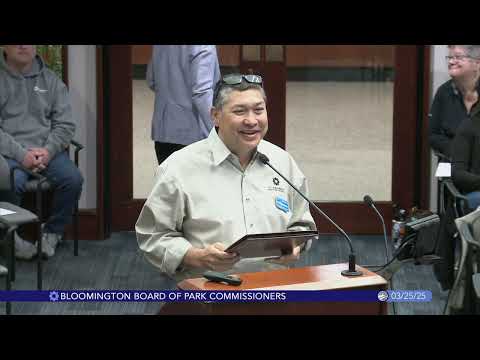
Haskell Smith, urban forester, asked the board to approve a contract with NativeView LLC to plant 380 trees in public rights-of-way as part of the bicentennial planting program — the third round of plantings funded by bicentennial bonds. “This is the third round of the bicentennial plantings,” Smith said. “All together now with the bicentennial funds, we've planted just under 2,000 trees.”
The board also approved a partnership agreement with Indiana University Bloomington’s Urban Forestry Research Group to administer pre- and post-planting surveys not to exceed $6,500, and renewed a partnership with Canopy Bloomington for the Tree Tenders program (not to exceed $15,000) that supports summer crews and equipment for tree care. NativeView’s representative, Ben Hertel, attended to answer questions.
Smith presented and the board approved an updated Urban Forestry Principles and Reporting policy (policy 13270) and a quarterly tree risk and reporting document. The quarterly report summarized 2024 activity: about 1,000 trees pruned, 410 removed and 825 planted. Smith said that, of roughly 19,200 trees with risk reports in the inventory, none were classified at the time as “extreme” hazard; 47 were high risk when the report was written and the number had dropped closer to about 30 by the meeting, and about 4.1 percent — roughly 800 trees — were moderate risk.
Commissioners asked about tree selection, homeowner notification and whether planted species are native. Smith said species were chosen from a list developed with the city’s Unified Development Ordinance and the Tree Commission, and that most plantings are native or “nativar” selections. The board approved all items by voice vote.
Staff will proceed with planting and survey work under the approved contracts and continue quarterly risk reporting to the board.