
Zoning commission backs revisions to townhouse rules, including smaller rear setback and return of parking tracks
Get AI-powered insights, summaries, and transcripts
Subscribe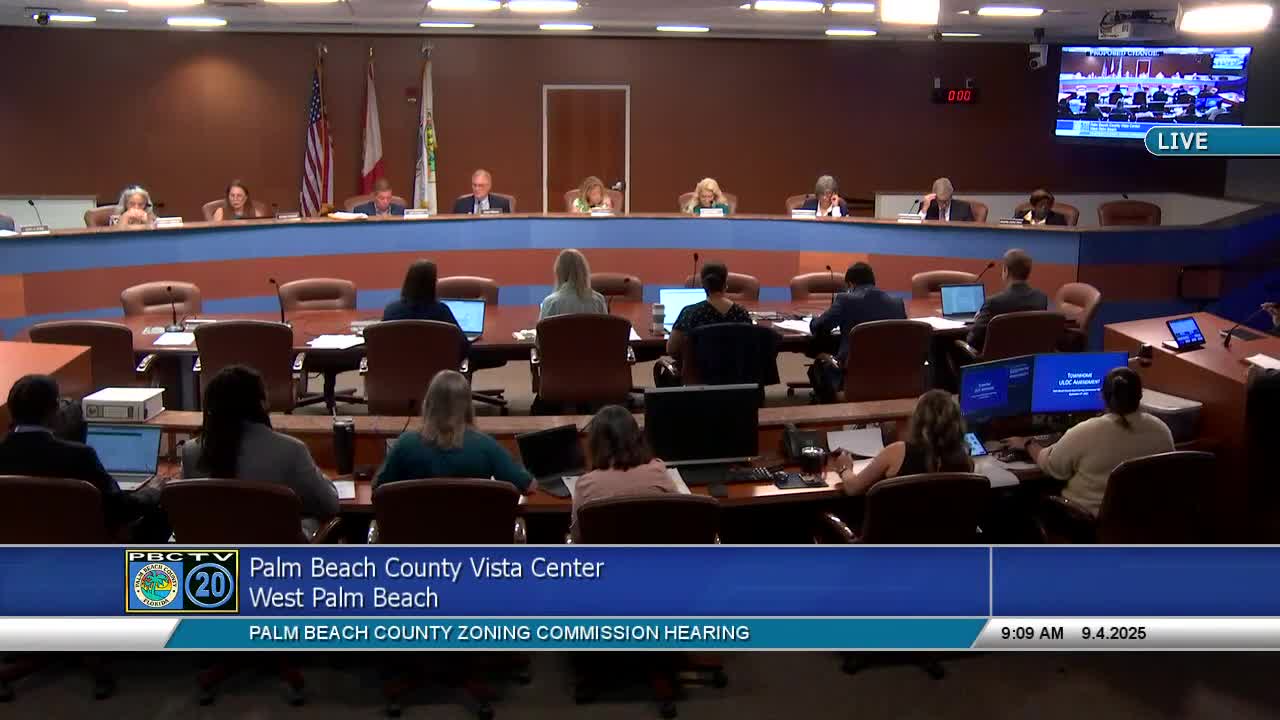
Summary
The Palm Beach County Zoning Commission voted to approve a privately proposed revision to the Unified Land Development Code that reduces townhouse rear setbacks from 25 feet to 15 feet and restores allowances for "parking tracks," staff and the applicant said.
The Palm Beach County Zoning Commission voted to approve a privately proposed revision to the county Unified Land Development Code (ULDC) that reduces townhouse rear setbacks from 25 feet to 15 feet and restores allowances for on‑site “parking tracks,” staff and the applicant said.
The change, initiated by a private applicant and refined by Zoning Division staff, was presented as a targeted edit to townhome regulations intended to allow more fee‑simple townhouse lots and to reduce a class of existing nonconformities created by earlier code changes.
Zoning Division staff said the applicant asked only for the rear‑setback change; staff drafted additional clarifications and related edits for the commission’s consideration. A staff presentation explained that the ULDC, as adopted in the early 1990s, imposed larger setbacks on townhouses than on comparable residential forms and that the proposed edits would align townhome rules with other residential use types and allow some developers to deliver fee‑simple townhome lots rather than condominium or multifamily products.
During public comment, local resident John Eubanks Jr. told the commission he opposed the package and warned of developer influence on private proposals. “The public hates it when developers take over what they think should have been the government,” Eubanks said, urging more outreach and detailed infrastructure review. Another speaker, Robert Palahunik, urged legal caution and said, “Reducing setbacks without corresponding infrastructure upgrades violates adequate public facilities requirements,” and called for traffic, drainage and independent engineering analyses.
Staff said engineering and stormwater staff reviewed drainage and that prior code language (including a 2014 provision related to parking tracks) was used as a basis for portions of the draft language. Staff also noted that the applicant’s original request was limited to the rear‑setback reduction and that several other edits in the packet were staff‑driven to address practical code enforcement and nonconformity issues.
Commissioners asked whether the language should use a broader term such as “community association” rather than the capitalized phrase “Property Owners Association,” a wording that could be read to exclude condominium forms; staff agreed to clarify the drafting. Commissioners also questioned whether engineering had weighed in on smaller drainage easements and pipe sizes proposed in the packet; staff replied that Land Development/engineering provided input during the review.
The commission, sitting as the Land Development Regulation Commission under Florida Statute 163.3194, adopted staff’s recommendation and approved the revisions presented as item 5. Staff noted that individual development applications—such as the Nash Trail project referenced by speakers—can still be reviewed project‑by‑project and that local decisions about setbacks or use of the revised rules remain available to future hearing bodies.
What happens next: the commission approved the staff‑drafted revision package and recorded its recommendation on the record. The changes will proceed through the administrative and Board of County Commissioners review steps required for ULDC text amendments and related ordinance actions. The commission and staff said the packet will be refined to correct drafting items and to clarify references to homeowner/condominium associations and engineering conditions before final county actions.