
Pretrial release program reports lower revocations, strong court-appearance and estimated jail-cost savings
Get AI-powered insights, summaries, and transcripts
Subscribe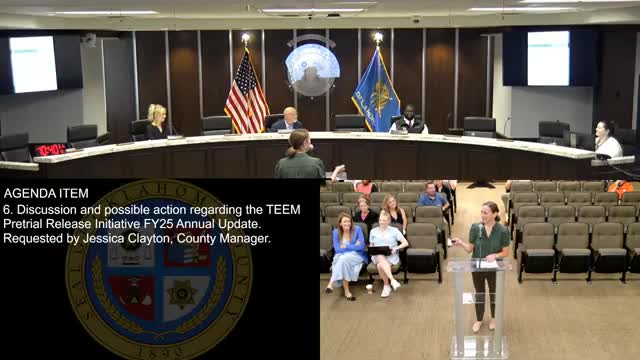
Summary
Team pretrial release staff reported screening 7,054 bookings, recommending 1,147 releases to judges with 1,140 approvals, and supervising 2,063 people; the program reported an 84% court-appearance rate, an 89% arrest-free rate while supervised, and an estimated $9.4 million detention cost savings.
Stacy Katzener, supervisor of the Team Pretrial Release Initiative, presented the program's annual update, including screening and supervision outcomes, and described a new risk-assessment implementation intended to reduce pre-release detention time.
The nut graf: the initiative reported that standardized screening and supervision produced high court-appearance and arrest-free rates and that the adoption of a validated Public Safety Assessment (PSA) aims to shorten the average time people spend in custody before release.
Stacy said the program screened 7,054 individuals with eligible charges and submitted 1,147 individuals to judges for pretrial release consideration; 1,140 of those submissions were approved. In total the program served 2,063 people; 1,841 were conditional pretrial releases, 152 were out-of-custody participants in the program for younger adults, and 140 were supervised on GPS monitors. Stacy reported an average of 18 days in custody before release and an average bond amount of $8,053. The program's court-appearance rate was 84 percent and the arrest-free rate while on pretrial release was 89 percent; bond revocations for failure to comply were 4 percent. The presenters said 37 percent of supervised individuals ultimately had charges dismissed and other favorable sentencing outcomes were reported: 23 percent diversion, 19 percent deferred sentences, 10 percent suspended sentences, 6 percent fines only, 3 percent county jail (usually with credit for time served), and 2 percent prison sentences.
Stacy and other presenters said the program had implemented the Public Safety Assessment (PSA) in the prior three to four weeks. The PSA is a validated risk tool that uses criminal-history data to estimate risk of failure to appear and risk of new criminal activity; staff said they were already seeing reductions in time to release for people processed with the PSA and projected 2 to 3 months to reach a steady operational pace that could reduce average pre-release detention to about 3 to 6 days for routine cases. Team staff said the program connects people quickly to services on supervision: substance-use treatment (725 referrals), mental-health treatment (749 referrals), housing gains (194 people), and employment and other immediate needs.
Stacy said the program's average cost of supervision is $6.78 per day compared with $66.49 per day for detention, and that the program's estimated detention-cost savings was $9.4 million (not including those whose bonds were revoked or who failed to appear).
Ending: The committee received the pretrial initiative's annual update; staff said they will continue daily screening and PSA use and work with court partners to expedite release where appropriate.
(Quotes are from identified speakers in the transcript and attributed accordingly.)