
High court hears argument on whether defense counsel’s refusal to seek plea was ineffective
Get AI-powered insights, summaries, and transcripts
Subscribe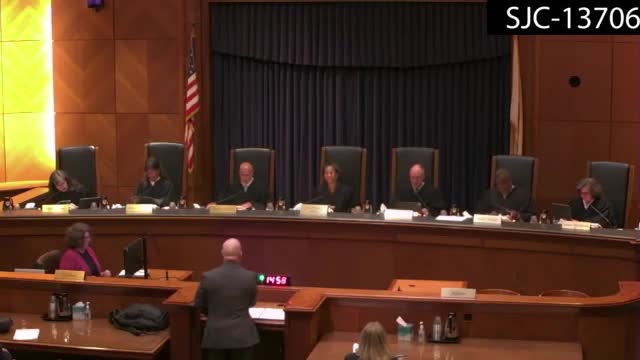
Summary
At oral argument in Commonwealth v. Gary Maso, defense counsel said the trial lawyer’s failure to pursue plea negotiations “fell measurably below” ordinary standards; the Commonwealth and the trial judge’s written ruling described the prejudice inquiry as too speculative.
The Supreme Judicial Court heard arguments over whether Gary Maso received ineffective assistance of counsel because his trial attorney allegedly never pursued plea negotiations, a failure defense counsel says may have left Maso facing life without parole.
The question before the court is whether a defense lawyer’s refusal to engage in plea discussions when a client requested them amounts to constitutionally deficient performance and, if so, whether the defendant can show the required prejudice when what would have happened in plea negotiations is necessarily uncertain.
Paul Rudolph, attorney for the appellant Gary Maso, told the court that the trial prosecutor testified in a later affidavit that Maso’s trial lawyer “never even approached him to discuss a plea” and that “that complete failure fell measurably below the level of an ordinary competent fallible attorney,” Rudolph said. Rudolph argued the prosecutor’s statement should be meaningful in assessing whether counsel abdicated a constitutional obligation and that the failure to pursue pleas cannot be treated merely as routine strategic decisionmaking when the client expressly asked counsel to seek a deal.
Rudolph said Maso did not learn of the prosecutor’s statement until 2016, when a co‑defendant, Anthony Sinnott, filed a motion for a new trial that included the prosecutor’s affidavit. Rudolph also told the court that the trial judge’s written decision is ambiguous about whether the judge credited Maso’s testimony that he asked his lawyer to seek a plea, and he asked the justices to treat the prosecutor’s later statement as evidence that raises a serious doubt about the outcome.
The Commonwealth disputed that argument. "Judge Reardon here correctly denied the defendant's fourth motion for a new trial where the defendant failed to establish that counsel rendered deficient representation or suffered any prejudice," said Donna Marie, an assistant district attorney representing the Commonwealth. She told the court that the trial judge, Judge Reardon, did not credit Maso’s assertions that he repeatedly asked attorney Clifford to seek a plea and that the judge’s denial relied on the Commonwealth’s opposition and the written record.
The trial prosecutor who later filed the affidavit (referred to in the record as ADA Alois) testified at hearings that he could not say definitively whether he would have accepted a plea from Maso alone — “I don't know what I would have done, but I think I would have done it,” the prosecutor said on cross‑examination — and the trial judge described the question of what would have happened in plea negotiations as impermissibly speculative. Rudolph urged the court to view the prosecutor’s equivocal testimony as creating a “serious doubt” under the state’s prejudice standard and to revisit whether the inquiry should be treated as structural or analyzed under prejudice doctrines derived from state case law.
The Commonwealth urged adherence to existing standards. Donna Marie noted factual and procedural difficulties: Maso’s trial counsel, Clifford, died in February 2008, making direct explanation of his choices impossible; Maso had limited in‑person contacts with Clifford before trial; and the record contained testimony suggesting Maso may have been seeking a manslaughter resolution rather than second‑degree murder. The Commonwealth also pointed to case law the parties cited (including this court’s decisions and U.S. Supreme Court authority) and argued that any claim that counsel’s omission is structural error is not established and that the prejudice inquiry — whether there is a reasonable probability the prosecution would have offered a plea, the defendant would have accepted it, and the court would have approved it — remains appropriate.
Both sides discussed the possibility of a remand for clearer factual findings. The Commonwealth told the justices that if the court did not find prejudice it would not object to remanding to Judge Reardon to clarify whether he credited Maso’s testimony and to make explicit findings about what the judge relied on in denying the motion.
The court’s decision will turn on whether the justices conclude (1) the trial record or later affidavit shows counsel refused to pursue plea negotiations after a client request and that such a refusal is per se structural error, or (2) counsel’s omission, if proven, must be tested under the court’s prejudice framework, which requires a showing that the outcome likely would have been different. The justices extensively questioned counsel on both the legal standard and the factual record during argument.
No ruling was announced at argument.