
Appeals court weighs whether driver shared lethal intent in Dacia Street drive‑by shooting
Get AI-powered insights, summaries, and transcripts
Subscribe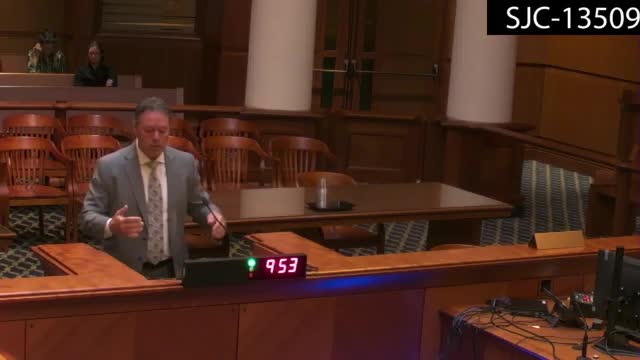
Summary
The Supreme Judicial Court heard arguments over whether evidence was sufficient to convict Michael Carlton as a participating driver in a drive‑by shooting, with defense counsel saying the shooting was unplanned and spontaneous and prosecutors pointing to vehicle maneuvering and post‑shooting conduct as indicia of shared lethal intent.
The Supreme Judicial Court heard oral argument on whether evidence was sufficient to convict Michael Carlton of sharing deadly intent as the driver in a drive‑by shooting on Dacia Street. Attorney Richard Hartquist, representing Carlton, told the justices the physical evidence shows an “unplanned and a spontaneous event” and argued the Commonwealth’s case relies on inferences rather than proof of the driver’s mental state. "All of the physical evidence ... illustrates that this is an unplanned and a spontaneous event that cannot be attributed to the driver of the vehicle," Hartquist said. He emphasized that the case should be evaluated in three phases — before, during and after the shooting — and argued that none of those stages supplied reliable evidence that Carlton knew his passenger had a gun or shared a murderous intent. Hartquist pointed to the lack of phone communications, the absence of a rental car or other indicia of prearrangement, and the car’s post‑shooting behavior — driving calmly to the co‑defendant’s mother’s house — as inconsistent with a planned joint venture. He also noted the stop sign at the scene and photographs and scene markers that, in his view, supported a theory of a spontaneous shooting rather than premeditation. The Commonwealth, represented by Erin Knight, urged the court to uphold the jury’s finding, saying the vehicle maneuvering and the passenger’s use of a laser‑sighted gun from the car support an inference of shared lethal intent. "This is not Baxter. This is not Baez," Knight told the court, distinguishing the line of cases in which the driver was divorced from the shooter and emphasizing that the facts here show the shooter fired from inside the vehicle while the driver positioned the car to facilitate the attack. Knight asked the justices to view the surveillance videos the prosecution submitted, describing the sequence of driving maneuvers — circling blocks and slowing as the target sat at the corner — as planning and participation. Both sides drew on case law the court has previously decided about when a driver may be culpable for a passenger’s use of a firearm. Counsel debated the extent to which slowing, circling the block, and coordinating with the passing of other vehicles permit a jury to infer shared intent rather than mere opportunity. The justices asked several clarifying questions, including whether post‑shooting conduct (such as where the driver parked the car and how he behaved afterward) may be considered as evidence of shared intent or merely as neutral flight conduct. Neither side reported a ruling from the court during the argument. The question before the justices is narrowly focused: whether the circumstantial evidence, viewed in the light most favorable to the Commonwealth, was sufficient to allow a jury to infer that Carlton shared the shooter’s lethal intent. The court also heard related argument about digital evidence and the seizure of a cellphone, matters the justices indicated they would address separately. No decision was announced from the bench during the argument; the case will proceed on the court’s timetable.