Get Full Government Meeting Transcripts, Videos, & Alerts Forever!
Get email alerts on the Wildfire Mitigation topic
No spam. Unsubscribe anytime.
Lawmakers hear wide-ranging wildfire briefing; state forester urges sustained funding, more crews and mitigation
Summary
At an Aug. 19 Joint Appropriations Committee meeting in Dubois, the Wyoming State Forester and county fire wardens described an intense 2025 season, recommended a larger, more predictable Emergency Fire Suppression Account and new state modules, and outlined costs and limits for inmate hand crews, aviation and invasive‑grass treatments.
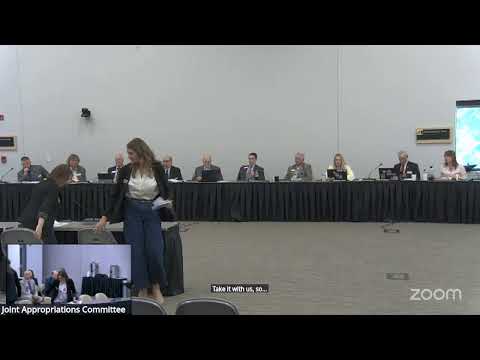
At a Joint Appropriations Committee meeting in Dubois on Aug. 19, Wyoming State Forester Kelly Norris told legislators the state is seeing more fires but fewer acres per fire this year and urged more predictable funding, expanded firefighting capacity and ongoing fuel‑reduction work to blunt escalating costs and risk. Norris told the committee, “Wyoming has had 755 wildfires that have burned approximately a 150,000 acres,” and said the state has seen more fires than at the same point last year while keeping many of those fires small through aggressive aviation and initial attack. The committee heard why the Emergency Fire Suppression Account (EFSA) is central to that strategy. Norris and county fire wardens described heavy use of aircraft, prepositioned suppression modules and out‑of‑state crews. Chad Cooper, fire warden for Sublette County Unified Fire, said quick aerial support and coordinated point‑protection tactics kept a June grass-and-sage fire to a mapped perimeter of 209 acres and saved homes that otherwise may have been threatened. Why it matters: Committee members were shown how a relatively small, fast response can avert multiweek, multimillion‑dollar incidents that would occur if fires reached timbered slopes or national forest. County officials said uncertainty about EFSA funding shifts fiscal risk to counties and fire districts and complicates response decisions. What was described: State forestry reported heavy use of aviation this year — the two state helicopters and four contracted single‑engine air tankers were repeatedly cited — and an active year for prepositioned state and interagency resources. Norris said the Red Canyon fire received a federal Fire Management Assistance Grant declaration in mid‑August, and that the state has committed roughly $15 million in cost shares to suppression so far in 2025. She said the Division has spent or committed about $15 million through EFSA cost shares this year, and earlier testimony put statewide mitigation spending (by the Wildland Trust) at $36.5 million of a $49.5 million allocation for invasive‑grass treatment and restoration. Several county fire wardens asked for two kinds of sustained investment: (1) a predictable, larger EFSA floor so the account is not drawn down to zero, and (2) new state “modules” — self‑sufficient, seasonal crews with leaders and supporting equipment that could be deployed for extended attack or second‑day staffing when volunteer firefighters must return to day jobs. JR Fox, fire warden for Campbell County, said a module “is a highly trained self‑sufficient crew designed for initial or extended attack,” and offered a biennial cost estimate of about $1 million per module (personnel) plus startup funding. Inmate hand‑crew (Smokebusters) program and DOC: The committee also reviewed the Wyoming Department of Corrections–run Smokebusters program. Dan Shannon, director of the Department of Corrections, described an established program based at Newcastle and said DOC can provide inmates for the state forestry crews but cannot expand capacity without beds, staff and supervision. Shannon provided a DOC estimate of roughly $19,000 per biennium for the officer‑supervision cost to stand up an additional crew at the Riverton Honor Farm; State Forestry estimated total startup and first‑phase costs for a Riverton crew at about $2,250,000 (with $750,000 per biennium for employees and $1.5 million in one‑time startup equipment and vehicles) and said it would take about four years to mature a second site. Norris and county wardens emphasized program limits: inmate crews cannot be airlifted to remote incidents, cannot bivouac without correctional supervision, and are restricted for security and training reasons. State forestry recommended strengthening the existing Newcastle program and developing a seasonal civilian module workforce as a longer‑term complement and career path for former Smokebusters. Mitigation and invasive‑grass work: Bob Budd, executive director of the Wyoming Wildlife and Natural Resources Trust, reviewed 2025 work on cheatgrass and other invasive annual grasses. Budd said newer herbicide options and expanded approvals for treatment on federal and state lands made a rapid, targeted program possible this spring and summer. He reported that about $36.5 million of the $49.5 million appropriation for invasive‑grass treatment and restoration has been spent or committed and that retreatment and restoration (reseeding, erosion control) will require additional funding in coming years. A voice from the field: Campbell County Chief JR Fox and Sublette County Chief Chad Cooper both described difficulties for volunteer departments when a fire extends past initial attack. Cooper said his volunteers were unavailable on the second day of a June fire because they had to return to paid jobs, forcing the county to order a federal engine for continued staffing. “The volunteers are getting worn out,” Cooper said; he and others told the committee that predictable state crews or modules would reduce second‑day gaps. Air operations and airports: Airport directors and local fire leaders described how aircraft and improved refueling bases multiplied statewide response capacity. Glenn Janowska, executive director of Casper‑Natrona County International Airport, said the airport’s expanded SEAT and large airtanker capability helped drop substantial volumes of retardant this season from the Casper base; he told the committee that Casper operations alone had flown more than 241,000 gallons responding to the Red Canyon fire at the time of testimony. Jeremy Barnum of Jackson Hole Airport described the local HeliTAC facility used for initial attack and search‑and‑rescue staging in Grand Teton National Park. Committee next steps and direction: No formal funding action was taken at the meeting. Committee members asked staff to return with more detail on several items — exact EFSA balance and burn‑season forecasting, module cost and siting options, Smokebusters capacity and DOC supervision costs, and mitigation grant mechanisms — and signaled support for pursuing more predictable suppression funds and increased mitigation funding. Co‑Chairman Baer and Chair Salazar said the committee will continue the conversation in subsequent meetings. Ending note: Witnesses repeatedly urged that up‑front investment in fuels mitigation and predictable suppression funding is cheaper than repeated emergency spending: Budd and state foresters cited a commonly used mitigation estimate that every dollar spent on prevention can reduce several dollars in later suppression and restoration costs, and multiple presenters said the optimal strategy is a mix of stronger initial attack (planes/helis/modules), improved second‑day staffing and continuous landscape mitigation.