
Panel weighs codifying 8% sales-tax direct distribution to local governments
Get AI-powered insights, summaries, and transcripts
Subscribe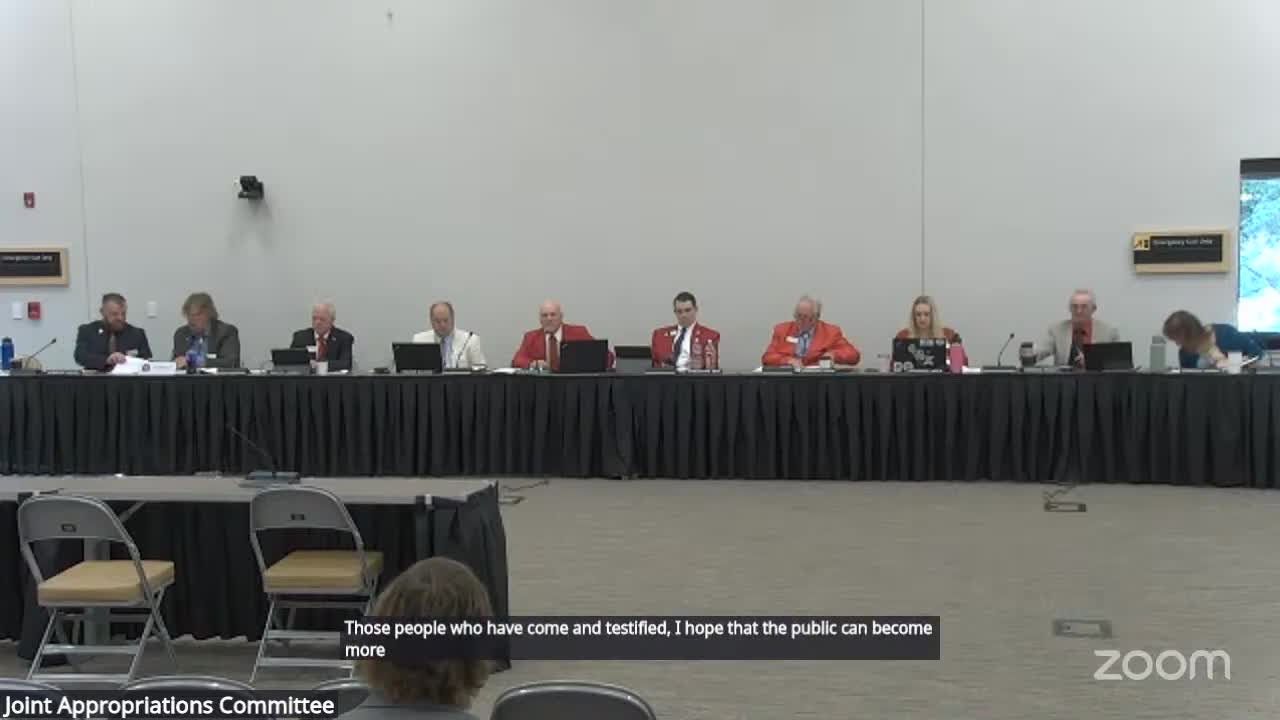
Summary
An interim legislative committee heard testimony on a proposal to move about 8% of statewide sales-tax revenue into an automatic direct distribution for cities and counties, a change proponents say would provide budgeting certainty and opponents say could tie local budgets more directly to statewide economic swings.
A state interim appropriations committee on Monday heard testimony on proposals to alter how Wyoming’s statewide sales-and-use tax is split between the general fund and local governments, including a proposal to codify roughly 8% of collections as an ongoing direct distribution to cities and counties.
The change discussed would move about $77 million a year from the general fund into a direct-distribution mechanism now approved by the Legislature every two years, proponents said. Committee members and agency staff said no bill was drafted or adopted at the meeting; the session was for testimony and fact-finding only.
Committee members said the item matters because the direct distribution affects local governments’ ability to plan and deliver basic services. "Local governments through the direct distribution receive 146,250,000.00 per biennium or more specifically, 73,125,000.000 per year," said Don Richards, Legislative Service Office budget fiscal administrator, describing current annual flows to local governments.
Why it matters
Proponents from the Wyoming Association of Municipalities and the Wyoming County Commissioners Association told the committee the proposal would give local governments more predictable revenue. Ashley Harpstreet, executive director of the Wyoming Association of Municipalities, said, "Wyoming municipalities are very dependent on sales and use tax revenues." Jeremiah Reiman, representing the Wyoming County Commissioners Association, told the panel his group’s recommendation is to "keep that 31% just the way it is" and to add an additional 8% routed through the Madden formula so the same hardship and base adjustments continue to apply.
Key details and administration
Staff described one administrative approach discussed in working groups to avoid costly Department of Revenue information-technology changes: keep the Department of Revenue’s current collections and general-fund accounting unchanged, and transfer the chosen percentage from the general fund to the Office of State Lands and Investments (OSLI) annually. "The 69% of the statewide 4% that goes to the general fund — that's essentially where the Department of Revenue's participation in that direct distribution really ends," Department of Revenue Director Brett Fanning said.
Under the approach favored by the administrative working group, the transferred amount would be based on the prior fiscal year’s collections to avoid complex midyear reconciliations. Richards said the proposal would move to payments on Oct. 15 and March 15 rather than the current Aug. 15/Jan. 15 schedule because accrual accounting data needed for the Madden formula are not final by mid-August.
Timing and first application
Staff told the committee the first year this method could take effect would be fiscal year 2027, using fiscal year 2026 collections as the base. That means local governments would receive a year-delayed share of ups and downs tied to statewide collections. "They would benefit from the highs, and then, the subsequent year, they would also absorb the declines," Richards said.
Budget and revenue notes
Richards and staff also reviewed related revenue estimates: the direct-distribution program currently provides about $73 million per year; WAM/WCCA proposed an amount roughly equal to an 8% carve-out from the statewide base, about $77 million annually. Richards reviewed historical estimates of the sales-tax-on-food exemption, noting LSO’s 2006 estimate of roughly $49 million at the time and a contemporary estimate, using adjusted comparisons, of about $68 million.
Local-government perspective and concerns
Local officials who testified said stability matters for small-town services. The mayor of Dubois (identified in the record as the mayor of DuBois) told the committee, "We just received $97,000 in our funds, and it will help replace the $84,000 that the town of Du Bois has lost in property tax income." Sandy Hoost, DuBois town clerk and treasurer, and Kyle Butterfield, city administrator of Riverton, described how direct-distribution dollars support sidewalks, water and sewer, law enforcement and other core services.
Several committee members pressed staff and local representatives about trade-offs: moving the amount into a statutory carve-out would remove the biennial appropriation debate, but it would tie part of local budgets to statewide economic swings rather than to local collections. "For the 31% distribution to local governments, they have ridden the wave of highs and lows of the state's tax collection," Richards said, adding that the Madden formula’s hardship and base components would continue to be used for the proposed added share.
Administrative risk and error history
OSLI staff told the committee that the agency currently performs the Madden-formula calculation and has a short manual-entry window to complete the distribution. Director Katie Barry said OSLI could continue the calculations under a statutory carve-out as long as the twice-yearly frequency remains. Richards and OSLI recounted past, limited errors in municipal allocations that were corrected in follow-up payments and said the working group favored a "not later than Oct. 15" payment deadline to allow sufficient time for accruals and reconciliation.
Next steps
Committee co-chairs and members emphasized they will continue deliberations in October and again during budgeting meetings in December and January and that no formal legislative action was taken at the meeting. Several members said the committee would aim to refine administrative details, confirm impacts on smaller counties that rely heavily on the existing direct distribution, and consider draft bill language before presenting a proposal to the full Legislature.
No action taken
Committee members unanimously reiterated during the meeting that they would not draft or pass legislation at that session; the hearing was a fact-finding and stakeholder-input meeting.