
New Kent supervisors told to weigh fall VRA borrowing as water system cash tightens
Get AI-powered insights, summaries, and transcripts
Subscribe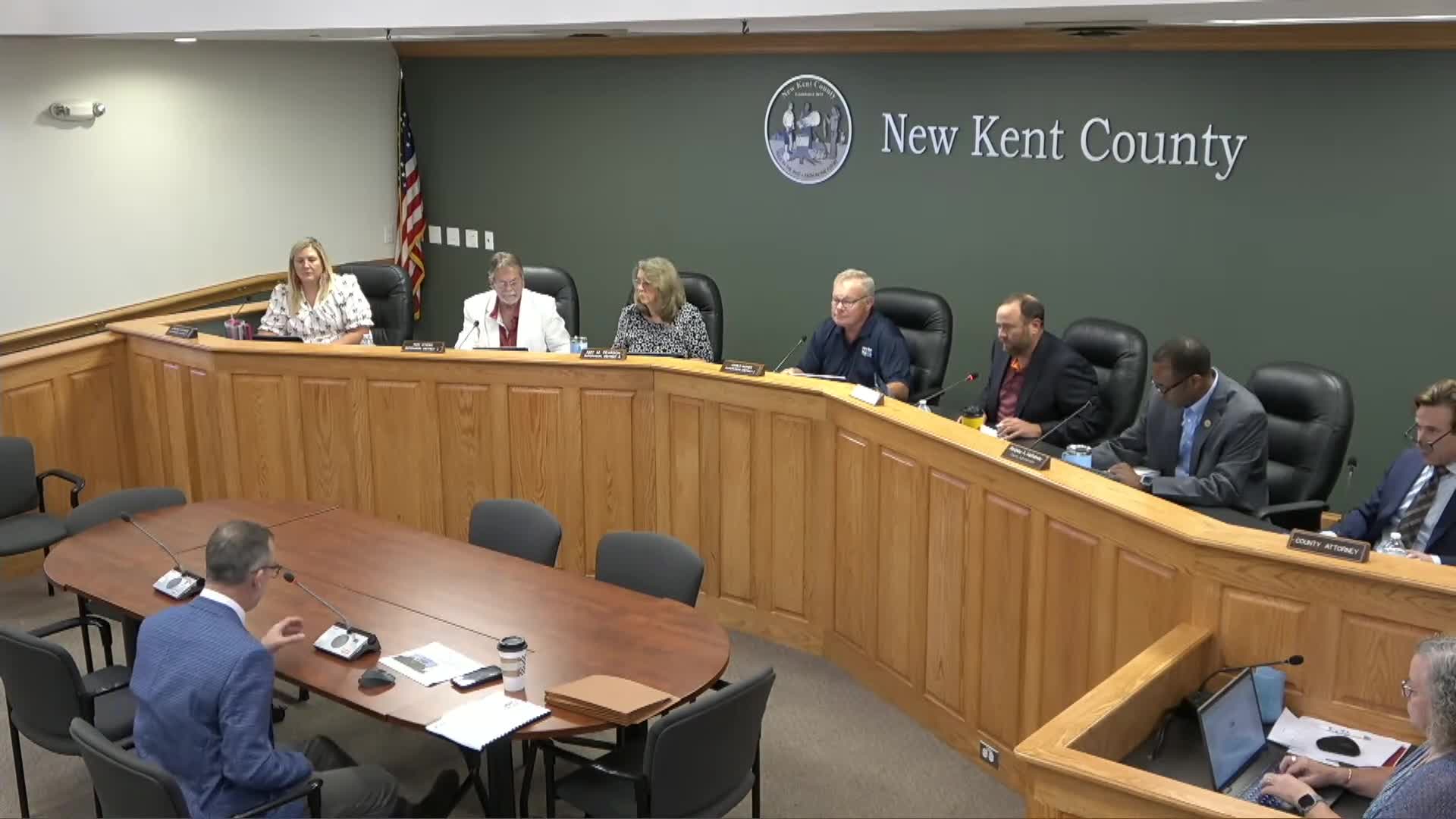
Summary
County staff told the Board of Supervisors that carry‑forward water projects and rising operating costs make borrowing likely in FY26; board will consider joining the Virginia Resources Authority (VRA) fall financing pool on Sept. 8.
Mike Lang, staff member, told the New Kent County Board of Supervisors on Aug. 29 that the county’s water capital improvement program faces immediate cash‑flow pressure and outlined options to reduce rate impacts while funding two high‑priority projects.
Lang said the top priority is a 1,000,000‑gallon tank for Brickshire and an interconnecting waterline along Route 249. “This is your number 1 water or utility priority right now,” Lang said, adding that Brickshire’s pressure measured 36 psi on a recent morning and that “there really are no suitable alternatives to this project.”
A finance presentation from consultants and county staff framed a near‑term borrowing decision. “If all of that funding occurs in fiscal year ’26, [the utility] would anticipate being below the reserve policy and perhaps would need to spend some of the restricted dollars that are restricted under your bond covenant,” a financial consultant said, urging the board to consider the VRA fall pool. The board was told a local approval on Sept. 8 would allow the county to participate in the VRA sale in late October and receive proceeds by November if it chooses.
Why it matters: the utility has roughly $23.5 million of carry‑forward project costs already encumbered; staff said those projects must be funded and that operating expenses have risen faster than customer growth. The county’s analysis shows a base need for additional revenue growth even without new capital borrowing, and adding the Brickshire tank and the Route 249 interconnect materially increases the five‑year revenue requirement unless other offsets are used.
Supporting details: Lang listed funding levers—grants (rare for a high median‑income county), connection and availability fees (which require development), user fees, and borrowing. He described examples the board could consider to raise revenue without increasing the headline user fee rate, including a change to irrigation billing, higher one‑time account fees and modest commercial rate adjustments. Lang estimated the Brickshire tank at $10.25 million and the Route 249 interconnect at $5.5 million; an alternative to the interconnect would be replacing a well at roughly $1 million, but that offers shorter‑term relief and could be obsolete once the interconnect is built.
The finance presentation tested scenarios that (1) maintained current policies, (2) shifted the county’s minimum cash policy from 50% of revenues to 50% of operating expenses, (3) layered on fee adjustments, and (4) altered debt amortization. The consultant said the base case requires roughly 1.2% additional revenue per year over five years (on top of the 4% already approved this year) to maintain policies; adding carry‑forward projects and Brickshire could raise that to roughly 2.6% per year in some scenarios.
Board action and next steps: no final borrowing motion was taken Aug. 29. Staff and the consultants told the board that a financing for at least the carry‑forward projects will likely be needed in FY26 to remain within reserve and bond covenant requirements, and that the board will consider whether to participate in the VRA fall pool at its Sept. 8 meeting. The consultants noted participating in the fall pool locks in current market rates but that waiting to the spring would expose the county to interest‑rate risk and month‑to‑month cash‑flow pressure.
Context and caveats: speakers repeatedly emphasized modeling assumptions (20‑year amortizations, a 5% interest assumption and one year of interest‑only to smooth debt service) and noted that the revenue outcomes depend on growth assumptions, expense performance and whether the county pursues rezonings that would generate connection fees. The presentation flagged that grants are unlikely because the county’s median household income is above $120,000, making many grant sources unavailable.
Looking ahead: the board will be asked Sept. 8 to adopt a not‑to‑exceed financing resolution if it wants to participate in the VRA fall pool; that action is time‑sensitive for the VRA schedule but the board retains discretion on the precise amount to borrow before the sale.