
Water Boards staff to consider splitting wastewater and MS4 stormwater matrices after debate on whether MS4 is "effluent"
Get AI-powered insights, summaries, and transcripts
Subscribe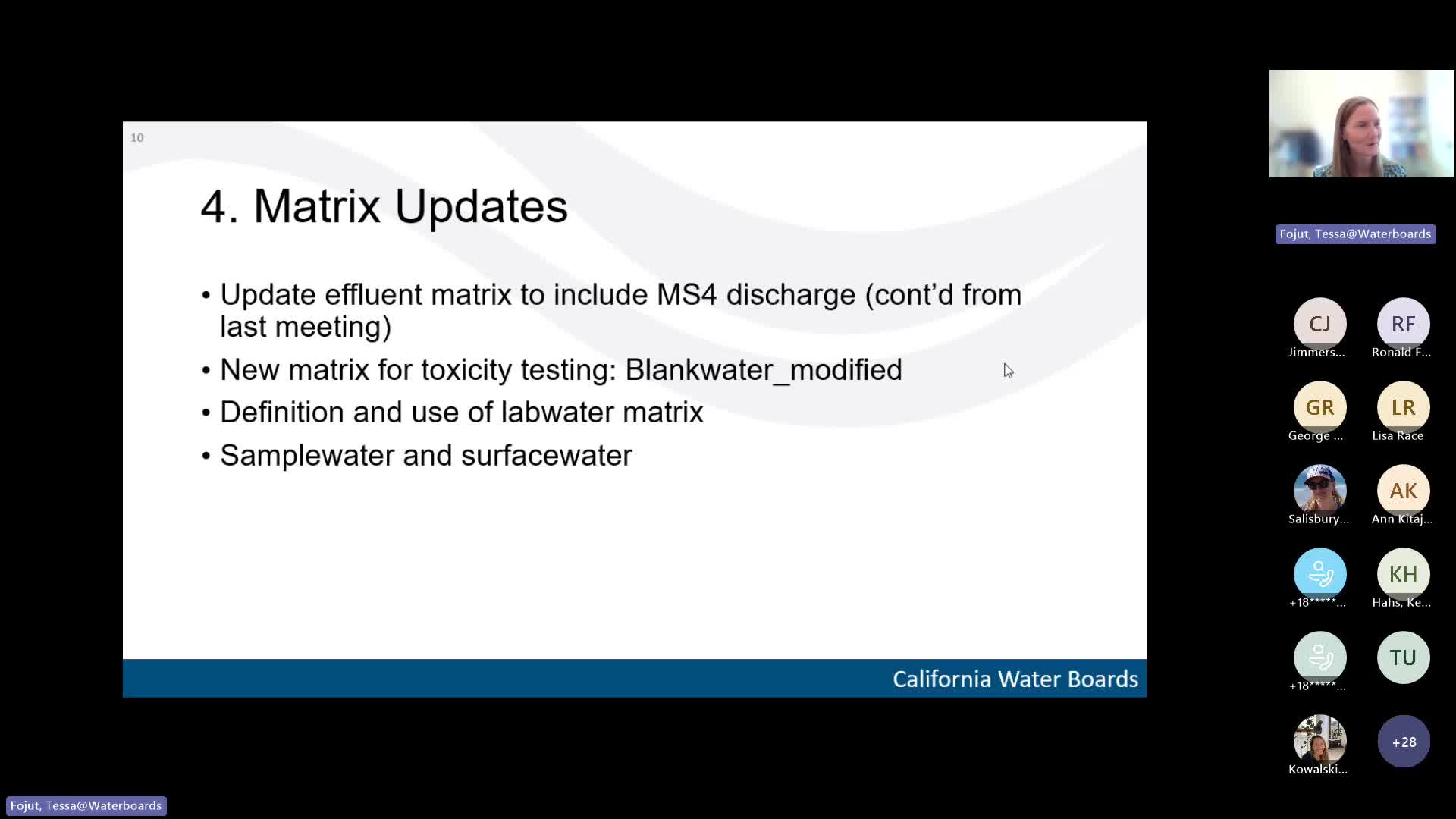
Summary
Tessa proposed adding municipal separate storm sewer system (MS4) discharges to the effluent matrix to group point-source permitted discharges; some attendees questioned whether MS4 is properly treated as effluent rather than runoff.
Tessa presented a proposal to update the effluent matrix description to explicitly include MS4 stormwater discharge, saying permitting staff advised that the intent was to distinguish point-source discharges covered by NPDS permits. "MS 4 stormwater is considered effluent, and so it belongs in the effluent description," she said, adding that including MS4 in effluent lets staff distinguish routine surface-water monitoring from permitted-effluent monitoring. Several participants pushed back. One attendee said the acronym MS4 stands for "municipal separate storm sewer system" and described it as rainfall-runoff that the MS4 operator cannot fully control, arguing that "it's not really point source at that point." Another participant recommended keeping detailed descriptions in both the runoff and effluent definitions so users can tell when to use each matrix. Tessa said she will take the feedback to internal program and permitting staff and consider creating two separate matrices (one for wastewater effluent and one for stormwater effluent) and report back at the December meeting. She said the current runoff matrix will remain; the immediate action is to refine descriptions and consider whether separate waste/stormwater effluent matrices better meet regional needs. Why this matters: how MS4 discharges are categorized affects which records are excluded or included in analyses (for example, routine ambient surface-water assessments versus permit-compliance monitoring). A change could affect historical data interpretation and how users select matrices when reporting results. Authority cited in the discussion included the Clean Water Act and NPDS permits, which staff cited when describing how regulators treat MS4 discharges.