
Flagler Schools outlines steps to steady bus service after early-year disruptions
Get AI-powered insights, summaries, and transcripts
Subscribe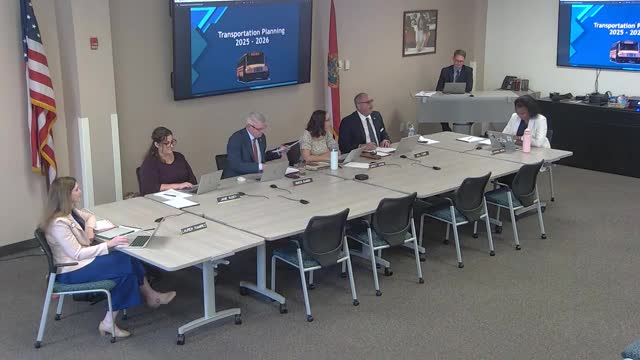
Summary
District transportation leaders told the school board they added driver allocations, will standardize routing and launch a public bus-status page while continuing recruitment and monthly route audits to reduce delays and safety risks.
Flagler County Schools transportation staff told the school board on Aug. 26 they increased staffing authorizations and are changing routing and communications to reduce late buses and safety risks. Stewart Walker, the district transportation lead, said the department was allocated 74 full‑time bus driver positions and has “just achieved 4 more allocations to that, which will take us up to 78 allocations.”
Why it matters: families judged service by whether a bus shows up; persistent delays and substitute shortages this fall prompted the update and short‑term fixes to provide clearer, real‑time information to parents and supervisors.
Walker said the district is also allocated 431 bus aides; it currently employs about 30 full‑time aides, four van drivers, two substitute drivers and 12 substitute aides. “We’re moving toward a standard routing scheme, which means that we’re going to permanent designated stops,” he said, adding the district is adopting a three‑tier routing model so the same vehicle serves elementary, middle and high school runs when feasible. Walker described monthly route audits to verify schedules, monitor ridership and identify safety or on‑time‑performance problems.
Board members pressed staff on staffing and safety. Board member Jenny Reddy said parents need to know immediately when a bus is late; she described a short‑term ‘‘bus status page’’ built by staff and IT as a temporary communications tool while the district pursues longer‑term integration between routing software and mass messaging platforms. Walker and IT staff confirmed the district uses EasyRouting for routing and customizable real‑time notifications by student, stop or route, and said some software coordination issues currently prevent full personalized messages.
Safety changes include a new kindergarten identification system: Walker described red, magnetized seat covers to mark kindergarten seats so substitutes and drivers do not release kindergarteners unless a supervising adult is present. He said the district will not let a kindergarten student off a bus “unless they have parental supervision.”
On substitute driver capacity, Walker said two substitute drivers is “not enough.” He described a hiring goal to fill all full‑time allocations and build a pool of 10–12 substitute drivers; he said the district is exploring ways to help applicants get commercial licenses and to work with local training providers. Superintendent Moore said the board increased transportation staffing allocations earlier in the month to provide immediate relief.
Discussion produced two clear directions: continue recruitment and training (including exploring District and Flagler Technical College connections for licensing), and further refine short‑term communications with a public bus‑status page plus longer‑term software integration to deliver route‑level alerts. Walker said route audits, the red‑K kindergarten measure and the bus status page are already in place and that the department will continue to build substitute capacity.
No formal policy changes or votes were taken; the report was provided for information and staff were directed to continue implementing the communication and routing changes while pursuing staffing increases and licensing solutions.