
Solid Waste Authority adopts FY26 budget, lowers some collection rates and raises special-waste tipping fee
Get AI-powered insights, summaries, and transcripts
Sign Up Free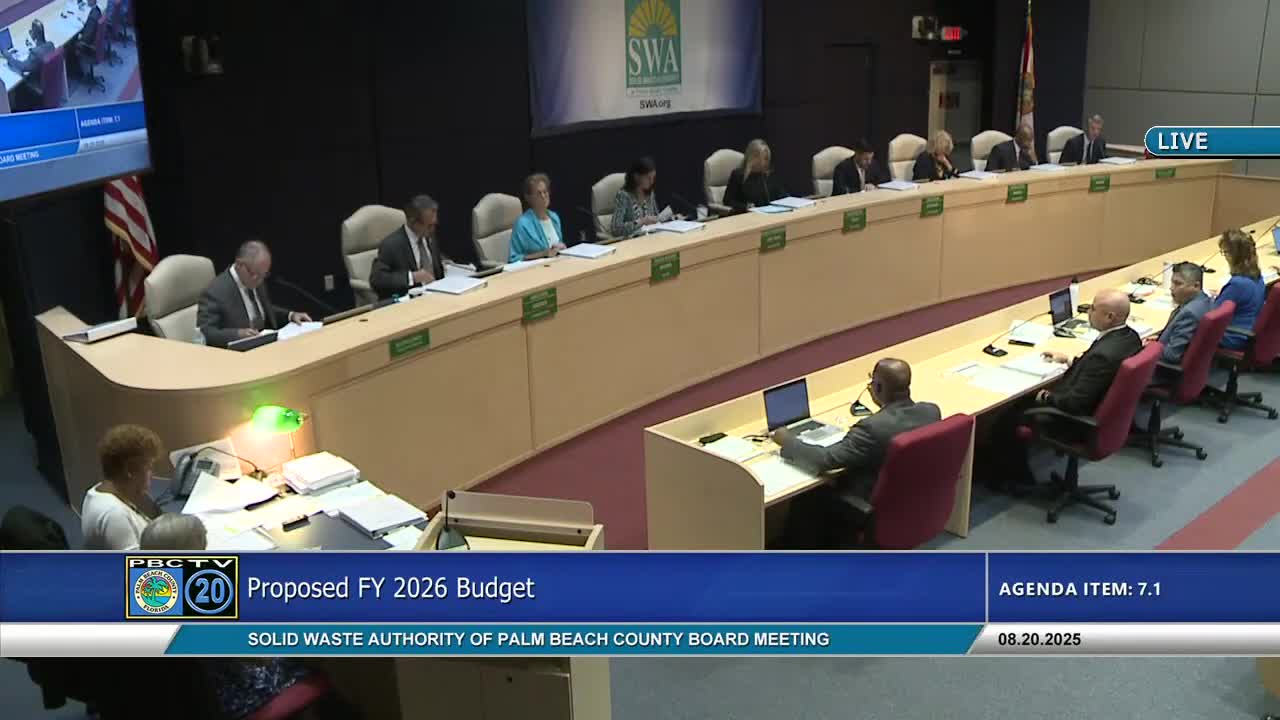
Summary
The Solid Waste Authority of Palm Beach County adopted its fiscal year 2026 budget, approved adjusted assessment and collection rates based on updated unit counts, and approved a $15 increase to the special-waste tipping fee to $80 per ton; the board approved related resolutions 2025-O2, 2025-O3 and 2025-O4 by unanimous vote.
The Solid Waste Authority of Palm Beach County on a 7-0 vote adopted its fiscal year 2026 budget, approved adjusted non-ad valorem assessment and collection rates and signed off on a revised tipping fee schedule, the authority said.
The board adopted the budget and the adjusted assessment and collection rates — reflected on property tax bills going out this November — and approved the tip-fee schedule along with three implementing resolutions: 2025-O2, 2025-O3 and 2025-O4. Commissioner Weiss moved to approve the budget items and Mayor Marino seconded; the votes were recorded 7-0.
Staff told the board updated unit counts from the property appraiser led to modest downward adjustments in single-family, multifamily and several commercial rates because costs are being spread across more units. The governmental rate remained largely unchanged because it is based on per-ton tonnage estimates, which did not materially change.
In the presentation, staff said overall revenue projections did not change substantially. On the expenditure side, updated insurance estimates trimmed that line and allowed a modest increase to the capital improvement program. Disposal assessment rates and tipping fees were described as changing only slightly. The one explicit fee change staff put forward and the board approved as part of the package was a $15-per-ton increase to the special-waste tipping fee, from $65 per ton to $80 per ton.
Why it matters: the assessment and collection rates are billed on property tax rolls as special assessments; changes affect all parcels included in the non-ad valorem assessment roll. Staff emphasized that unit-count adjustments — not new operating programs — produced most of the rate relief for many classes. The tipping-fee change reflects increased disposal costs.
Supporting details: staff asked the board to adopt the fiscal year 2026 budget, approve adjusted assessment and tip-fee rates, and adopt the three resolutions (2025-O2, 2025-O3 and 2025-O4) that implement the mandatory disposal and collection program, establish property classifications and adopt the annual assessment roll. The board took the actions in a consolidated vote and then adopted each resolution separately; each carried 7-0.
What the board did not decide: staff noted some related collection-area boundaries were discussed elsewhere on the agenda and remain subject to further board direction; the rate adoption itself proceeded without further boundary changes.
The authority’s staff said the formal documents — the adopted rate schedules, the approved resolutions and the full budget presentation — will be provided to the public and included on the authority’s website.