Get Full Government Meeting Transcripts, Videos, & Alerts Forever!
Get email alerts on the Civics Education topic
No spam. Unsubscribe anytime.
Remington students present civics action projects; one student focuses on autism awareness
Summary
Eighth‑grade civics projects were presented to the Franklin School Committee, including a Remington student who surveyed classmates and prepared a peer presentation to correct misconceptions about autism.
Teachers and eighth‑grade students described the civics action‑project program and presented examples of student work to the Franklin School Committee, including a student project on autism awareness.
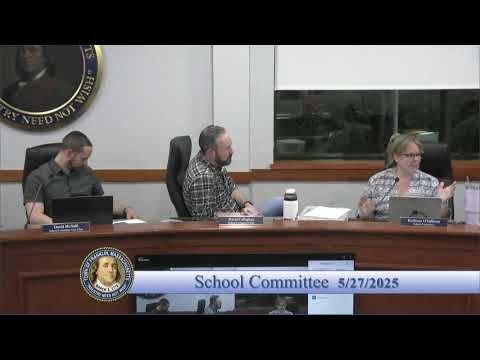
Dr. Frasier introduced the civics presentation and invited a teacher and student from Remington to speak. "This project makes [teaching civics] a walk in the park," said teacher Ms. Ambrose, describing how the action projects ask students to research local issues, identify root causes and take concrete action steps.
Kaylee, a Remington student, said she chose autism awareness because she is autistic and wanted peers to better understand autism. "I chose this issue because I'm autistic and want to help people better understand autism," Kaylee said. She described surveying 50 Remington students to identify knowledge gaps, producing informational posters and an interactive quiz to present to seventh graders, and sharing terminology (for example, "stimming," "special interest," "overstimulated," "masking") to help classmates recognize common experiences and responses.
Kaylee displayed a slide that presented a non‑linear visual of the autism spectrum and explained practical classroom guidance for peers: speak in a quieter voice, do not force eye contact, ignore stims, ask follow‑up questions about special interests and respect requests for space. After the presentation, multiple School Committee members praised the clarity and organization of the project and encouraged expansion of the town hall visits that allowed students to meet local department representatives.
Ms. Ambrose and the district said the civics project culminates in varied action steps — from letters to officials and town events (the district mentioned a student‑run fishing derby at Beaver Pond scheduled for June 14) to peer education and website creation — and is designed to build civic skills and knowledge of local government. The presentation was informational; the committee did not take formal action.