Get Full Government Meeting Transcripts, Videos, & Alerts Forever!
Get email alerts on the Education District Policy topic
No spam. Unsubscribe anytime.
Franklin Public Schools lays out district improvement plan, keeps Illustrative Math for grades 6–8
Summary
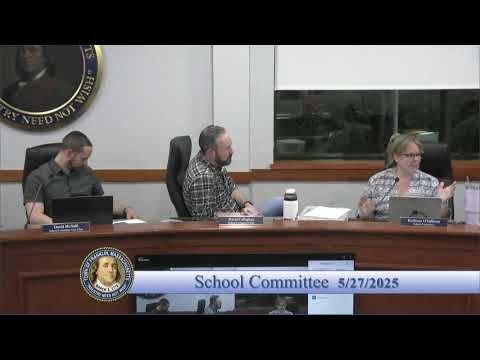
Superintendent Jager and district leaders presented a multi‑year district improvement plan focused on social‑emotional learning, curriculum adoption and implementation, professional learning, and two new middle‑school math specialist roles; the board received the presentation as information.
Superintendent Jager and Franklin Public Schools leaders presented the district—s multi‑year improvement plan and an update on curriculum work, including decisions on middle‑school math and new staffing to support instruction.
The plan centers on four strategic objectives: promoting social‑emotional learning and belonging; implementing high‑quality, standards‑aligned curriculum; strengthening instruction through professional learning and tiered supports; and improving two‑way communication with families and staff. "You do not rise to the level of your goals, but you fall to the level of your systems," Superintendent Jager said, describing the district—s focus on building systems to sustain the work.
District officials said the work is tied to the Franklin Public Schools Portrait of a Graduate and noted timelines that include June 18 as the last student day, a leadership debrief on June 20 and summer planning and an administrative retreat in August. The district will present school and district improvement plans publicly in September and October and expects to use data systems such as Panorama and Aspen to monitor social‑emotional and academic trends.
On social‑emotional learning, the district reported efforts to restore restorative practices, pilot a support block at Franklin High School, and expand consistent SEL instruction with tools such as Panorama, the Panorama Playbook, Second Step, and Zones of Regulation. District staff said they are evaluating SEL screening tools to guide tiered supports and that counselors are piloting Panorama to log tiered interventions.
Curriculum work was presented as a cyclical five‑phase review: study, plan, present, implement and monitor. The Office of Teaching and Learning said it will publish a public version of that cycle next year and align multiyear budget projections to sustain implementation. The district described ongoing adoption and calibration work across grade bands, citing examples such as HMH Into Reading for humanities and localized adoption of OpenSciEd in middle school science and AP resources at the high school.
On middle‑school math, district leaders said they will continue to use Illustrative Math as the core 6–8 program. They reported changes to accelerated course labeling and scope: the Grade 7 accelerated option is now referred to as "Pre‑Algebra" with a compacted scope and Grade 8 accelerated math will be aligned and named "Algebra 1" to match the high school Algebra 1 course. The district also said it revised entrance and exit criteria for accelerated classes to ensure students entering those sections have foundational grade‑level skills.
To support instruction and interventions, the district plans to add two middle‑school math specialist positions for next year to help with pre‑teaching, reteaching, differentiated interventions, enrichment, and using data to target supports. The district said these roles mirror supports already used at the elementary level.
Officials described expanded professional learning that includes district book studies, educator‑led sessions, and opportunities for staff to earn endorsements and self‑paced coursework. The district highlighted a November full‑day professional learning event that included cross‑level panels, book studies, self‑care options for staff and sessions run by district educators. "Learning from, with and for one another" was presented as a central design principle.
District leaders tied communication work to the ongoing reorganization and redistricting process: they said a reorganization website, boundary listening sessions and direct communications tools (notifications, social media and school‑level newsletters) were used to share updates and to develop a new district website. The presenters said much of the next phase of communication will be delivered at the school level to welcome families into new school communities while the district continues some centralized updates.
The presentation was informational; no formal policy vote or action was taken at the meeting. Committee members asked for more quantifiable outcome measures tied to improvement objectives and for future reports that show baseline data and measurable change. District staff agreed to continue monitoring via Panorama/Aspen and to provide follow‑up metrics in future updates.