U.S. Sentencing Commission split on retroactivity; vote fails to make mitigating-role cap retroactive
August 11, 2025 | United States Sentencing Commission, United States Courts, Judiciary, Federal
This article was created by AI summarizing key points discussed. AI makes mistakes, so for full details and context, please refer to the video of the full meeting. Please report any errors so we can fix them. Report an error »
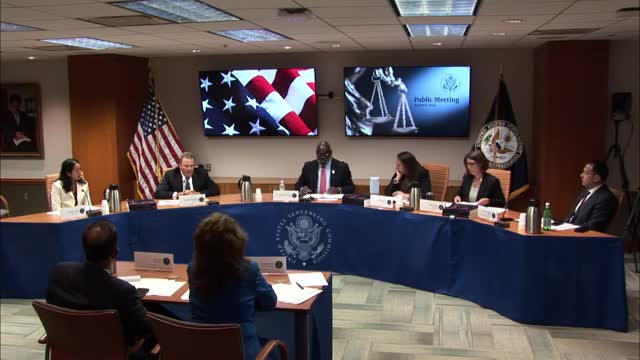
The United States Sentencing Commission voted on whether to make subpart 1 of part A of amendment 8.33 — a change to the mitigating-role cap — retroactive and failed to secure the necessary votes. The commission’s general counsel told commissioners the agency had solicited public comment, published a retroactivity impact analysis and held a public hearing; staff had proposed an effective date of Nov. 1, 2025, if the amendment were promulgated.
Chair Carlton W. Reeves framed the debate around “data and democracy,” saying the commission must weigh administrative burdens against the costs of continued incarceration. Reeves noted an estimated annual per-inmate incarceration cost and told commissioners, “Those costs need to be calculated clearly, I believe, and they must be weighed against all other administrative costs, including the cost of administering imprisonment.”
Several commissioners urged retroactive application. Vice Chair Laura Maitre said the commission’s impact analysis estimated an average sentence reduction of about 12 months for eligible cases and argued that eligibility would generally be clear from case papers and thus pose a lower administrative burden than other retroactive amendments. Vice Chair Louis Felipe Restrepo said retroactivity “advances the purposes of sentencing articulated in Title 18, United States Code, Section 3553(a), produces meaningful impacts for a broad group of defendants and presents a limited administrative burden.”
Opponents argued for preserving finality and warned of administrative strain on courts and probation offices. Commissioner Candace Wong said finality “is essential to our system of determinate, predictable sentencing” and cited formal opposition from the Criminal Law Committee of the Judicial Conference, the Probation Officers Advisory Group and the Victims Advisory Group, as well as the Department of Justice. Vice Chair Claire Murray said past retroactive rule changes produced many ineligible filings and cited that experience: “Fully 78% of 0-point applicants and 70% of status-point applicants were completely ineligible under the retroactive amendment,” she said, and cautioned that screening and motions would consume scarce judicial resources.
Commissioners debated the magnitude of potential relief. Opponents noted the commission’s retroactivity impact analysis estimated roughly 650 defendants could be eligible and that about 95% of those would see a one- or two-level change with more than 60% receiving a reduction of one year or less; some eligible cases had already received downward variances such that their original sentences fell within the amended guideline range. Supporters countered those figures by emphasizing the human and fiscal cost of additional days of incarceration and the commission’s duty to promote uniform sentencing.
After discussion, the chair called for a vote; the motion to promulgate retroactive treatment failed. The chair recorded that fewer than four commissioners voted in favor, so the proposed retroactive application was not adopted. The commission encouraged stakeholders and practitioners to follow posted materials and analyses at www.ussc.gov.
Chair Carlton W. Reeves framed the debate around “data and democracy,” saying the commission must weigh administrative burdens against the costs of continued incarceration. Reeves noted an estimated annual per-inmate incarceration cost and told commissioners, “Those costs need to be calculated clearly, I believe, and they must be weighed against all other administrative costs, including the cost of administering imprisonment.”
Several commissioners urged retroactive application. Vice Chair Laura Maitre said the commission’s impact analysis estimated an average sentence reduction of about 12 months for eligible cases and argued that eligibility would generally be clear from case papers and thus pose a lower administrative burden than other retroactive amendments. Vice Chair Louis Felipe Restrepo said retroactivity “advances the purposes of sentencing articulated in Title 18, United States Code, Section 3553(a), produces meaningful impacts for a broad group of defendants and presents a limited administrative burden.”
Opponents argued for preserving finality and warned of administrative strain on courts and probation offices. Commissioner Candace Wong said finality “is essential to our system of determinate, predictable sentencing” and cited formal opposition from the Criminal Law Committee of the Judicial Conference, the Probation Officers Advisory Group and the Victims Advisory Group, as well as the Department of Justice. Vice Chair Claire Murray said past retroactive rule changes produced many ineligible filings and cited that experience: “Fully 78% of 0-point applicants and 70% of status-point applicants were completely ineligible under the retroactive amendment,” she said, and cautioned that screening and motions would consume scarce judicial resources.
Commissioners debated the magnitude of potential relief. Opponents noted the commission’s retroactivity impact analysis estimated roughly 650 defendants could be eligible and that about 95% of those would see a one- or two-level change with more than 60% receiving a reduction of one year or less; some eligible cases had already received downward variances such that their original sentences fell within the amended guideline range. Supporters countered those figures by emphasizing the human and fiscal cost of additional days of incarceration and the commission’s duty to promote uniform sentencing.
After discussion, the chair called for a vote; the motion to promulgate retroactive treatment failed. The chair recorded that fewer than four commissioners voted in favor, so the proposed retroactive application was not adopted. The commission encouraged stakeholders and practitioners to follow posted materials and analyses at www.ussc.gov.
Don't Miss a Word: See the Full Meeting!
Go beyond summaries. Unlock every video, transcript, and key insight with a Founder Membership.
✓
Get instant access to full meeting videos
✓
Search and clip any phrase from complete transcripts
✓
Receive AI-powered summaries & custom alerts
✓
Enjoy lifetime, unrestricted access to government data
30-day money-back guarantee
