
School committee approves 2025–26 family handbooks; high school adds WIN block, revised tardy policy and AI language
Get AI-powered insights, summaries, and transcripts
Subscribe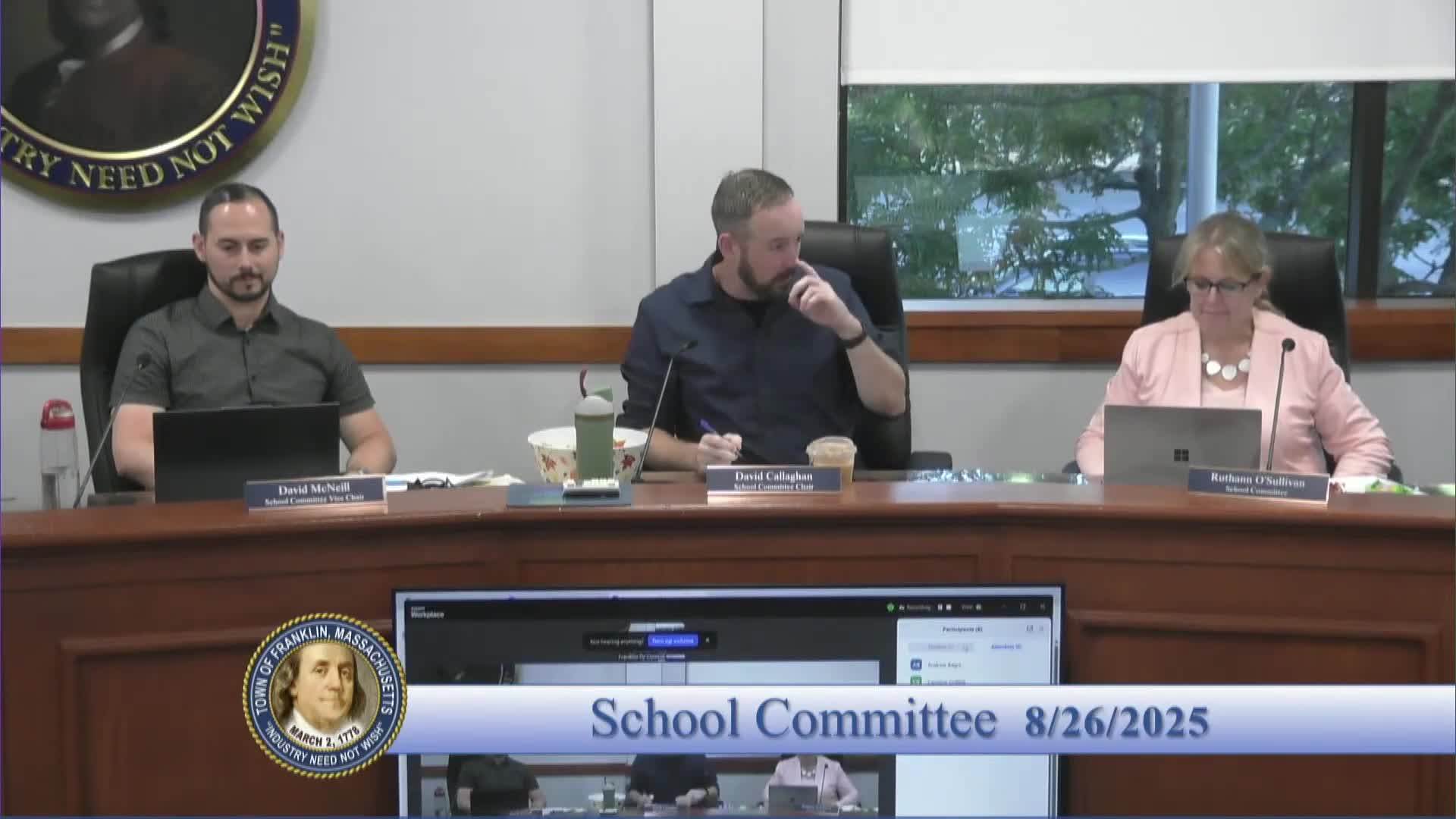
Summary
The committee approved handbooks for ECDC, elementary, middle and Franklin High and heard substantive changes at the high school that add a 30‑minute WIN (What I Need) block, a revamped MTSS‑aligned tardy intervention and language about artificial intelligence in academic‑dishonesty guidance.
The Franklin School Committee voted Aug. 26 to approve the 2025–26 family handbooks for the district’s ECDC, elementary, middle and high schools. The committee also heard three substantive high‑school changes officials described as the most consequential for students: a 30‑minute WIN block for personalized supports, a revised tardy policy grounded in the district’s MTSS framework, and added language on artificial intelligence in the academic‑dishonesty section.
Committee action: The committee approved the four handbooks in separate motions; votes were recorded as aye and each motion passed. The committee moved and seconded each handbook approval on the Aug. 26 agenda.
WIN block: Franklin High School administrators described the new daily 30‑minute WIN ("What I Need") block as a student‑choice and teacher‑directed support period. "Students can choose, to get extra help or enrichment from a teacher. Teachers can also schedule students themselves," the high school administrator said. The district plans to introduce students to the scheduling process during home‑base meetings the first full week, with the WIN block fully operational after that.
Tardy policy: The high school team said data showed traditional punitive consequences for tardiness (for example, assigning detention hours) were ineffective. The revised policy will use Panorama and an MTSS approach to provide earlier parental engagement and tailored interventions. A committee member requested follow‑up data; administrators agreed to provide a progress update around three months into the year (suggested: November, around the end of the first quarter).
AI and academic dishonesty: The high school handbook adds an explicit reference to artificial intelligence in its academic‑dishonesty language and reserves the possibility for teacher‑approved, ethical use of AI for some tasks. The district said it will devote a half‑day of professional development (in December) to AI and is reviewing DESE guidance issued Aug. 17. "AI itself and how it's being used in our society is such a big issue that...it really behooves us as a district," a district official said.
Other levels and alignments: Administrators said there were no substantive changes at the elementary and middle levels; the elementary schools were consolidated into a single elementary handbook to align practices across buildings. The handbooks were updated with current contact information and language on parents' rights to request curriculum accommodations.
Ending: The committee approved all four handbooks. Administrators said families will receive a Google form to sign off on handbook receipt, photo releases and digital‑tools consent; the district will set a due date for those signoffs and encouraged families to complete them before the start of school.