Get Full Government Meeting Transcripts, Videos, & Alerts Forever!
Get email alerts on the Enrollment topic
No spam. Unsubscribe anytime.
Lakewood superintendent to recommend actions after decade-long enrollment decline
Summary
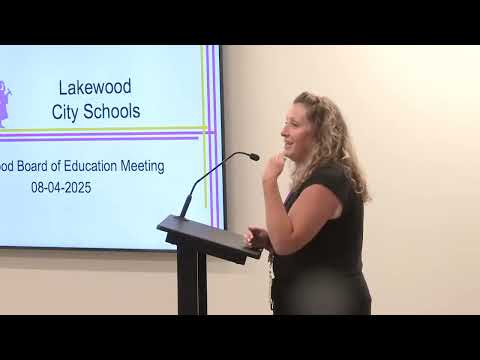
Superintendent Nitswicki told the Lakewood City Schools Board of Education the district has tracked a decade-long enrollment decline and will prepare a recommendation to the board this school year; any building-use changes earliest to be implemented in 2026–27 school year.
Superintendent Nitswicki told the Lakewood City Schools Board of Education that district leaders have examined 10 years of enrollment data and will prepare a recommendation to the board this school year to address a continuing enrollment decline.
The decline, Nitswicki said, affects facilities, personnel, scheduling and class sizes and will require “the best interest of our students” to steer any recommendations to the board.
Nitswicki said her administrative leadership team has ‘‘recently looked at current student enrollment information’’ and will continue to review trend data from the past 10 years. She said the trend ‘‘compels our immediate and continued attention’’ and will affect multiple district considerations going forward. She said the district will provide regular updates through her superintendent’s report and other communications as it develops recommendations.
Board members and staff clarified timing: any changes to the use of elementary school buildings would not be implemented earlier than the 2026–27 school year, and the superintendent will present recommendations to the board at a later date for the board’s consideration. Treasurer Kent Zeman provided context on the district’s state funding, saying a recent budget included a performance supplement that, based on the district’s ratings, will add roughly $200,000 per year to the district’s forecast, about $800,000 over the forecast period. Nitswicki and others reiterated that doing nothing “may no longer be an option.”
The superintendent emphasized that recommendations will be driven first by students’ interests and second by affirming community values. She acknowledged that the process ‘‘may look different’’ and that change can be difficult for families and staff, but said the district will aim for transparency as it proceeds.
The board did not take a formal vote on any structural change at the meeting; Nitswicki described the item as an ongoing administrative analysis that will culminate in a formal recommendation to the board.
Board members asked for timeline clarifications during the meeting and were told that the task force that reviewed elementary schools had been expected to conclude in May and that a recommendation from the superintendent would follow; the earliest implementation date discussed remains the 2026–27 school year. The superintendent said the district will ‘‘press forward’’ with continued analysis and will present a recommendation to the board sometime during the year.
Readers should note that specific future actions, locations, dollar impacts, or proposed closures were not specified at the meeting; the superintendent said details will come as the administrative team completes its analysis.