
Planning commission approves Sanctuary Phase 1 plat after debate over emergency access
Get AI-powered insights, summaries, and transcripts
Subscribe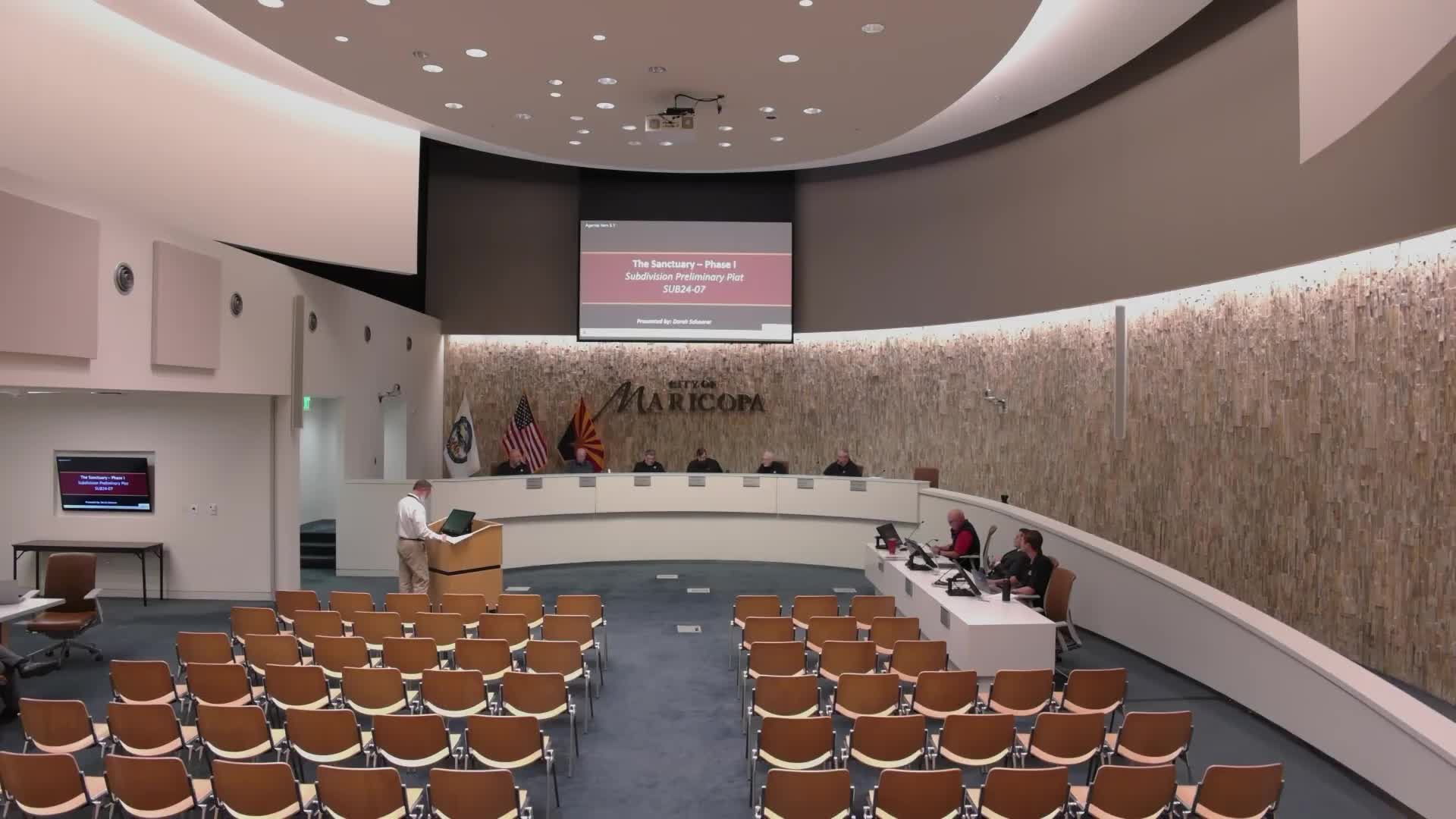
Summary
The Planning and Zoning Commission approved the Sanctuary Phase 1 preliminary plat for 339 single‑family homes on about 83.02 acres after a tie vote, extended discussion on a temporary 'all‑weather emergency access' and a request that staff research secondary‑access practices.
The City of Maricopa Planning and Zoning Commission on a subsequent motion approved SUB 24‑07, the Sanctuary Phase 1 preliminary plat, a proposal to subdivide roughly 83.02 gross acres to accommodate 339 single‑family homes.
The vote followed extended discussion focused on whether the subdivision should be required to construct a full secondary access as part of Phase 1, or whether a temporary all‑weather emergency access is acceptable until later phases are built out. The commission tied initially on a motion to approve, sent the item into an executive session for further discussion, then approved the plat when the commission reconvened.
Derek Shearer, Planning Division, presented the application on behalf of Development Services, saying the Phase 1 plat shows a mix of lot sizes and that the overall Sanctuary development could ultimately include about 1,191 single‑family units. Shearer described Phase 1 as approximately 153 lots sized 40 by 120, 99 lots sized 45 by 120 and 87 lots sized 50 by 120 and noted the phase is bisected by a collector road (West Lulu Jane Drive) and includes a primary amenity park and several pocket parks.
City Engineer Eduardo (role identified in the meeting as the city engineer) answered technical questions about the proposed temporary access. Eduardo told commissioners that touching an existing irrigation easement along Casa Grande Highway would trigger requirements to place the irrigation line underground for a long distance and said, “the rule of thumb is that if you touch any of that easement, you have to go underground the whole area,” which he estimated could add roughly $1.8 million to underground the irrigation pipeline. Eduardo also estimated the road improvements would be in the range of $2,000,000, and said the combination of those costs divided by the roughly 300‑plus lots under discussion would amount to roughly $10,000–$12,000 per rooftop.
Several commissioners pressed on public‑safety and long‑term maintenance concerns. Commissioner Robertson said the item had been continued previously “due to questions about the access road” and emphasized the desire to avoid residents being landlocked if phases are occupied before a final secondary access is built. Commissioner Club expressed concern about market risk, warning that “if we do go into recession, they walk away. It becomes a zombie development,” and said the city could be left to address access if a developer abandoned the project.
Staff and the city engineer described how maintenance responsibility for the temporary access is intended to fall to the homeowners association (HOA) rather than the city or the developer once the HOA takes ownership. Eduardo said the city would retain mechanisms to step in and perform maintenance if the HOA failed to keep the access in service, and the city could charge the HOA for that work.
The commission first voted on a motion to approve that resulted in a 3‑3 tie and therefore failed. The commission then recessed into executive session and reconvened. A second motion to approve SUB 24‑07 was made by Commissioner Robertson and seconded by Vice Chair Horace; the motion passed on the subsequent vote. The staff report recommended approval subject to the written conditions of approval in the staff packet and any further amendments the commission adopted.
Separately, the commission asked staff to research how other cities handle temporary secondary access and to report back; Director/Staff indicated an available meeting date of August 11 for that report. The commission requested that staff present municipal policy options addressing gate/keyholder policy, emergency access activation and ownership/maintenance timing for access improvements.
No new local ordinances or code language were created at this meeting; the commission’s approval was of the preliminary plat subject to the standard conditions in the staff report and any stipulations adopted during the meeting.
The commission’s action moves the project to the next steps in the development process, which include preliminary engineering and final plat review where specific construction plans and any required offsite improvements will be examined in detail.