Get Full Government Meeting Transcripts, Videos, & Alerts Forever!
Get email alerts on the Transportation Infrastructure topic
No spam. Unsubscribe anytime.
VDOT explains phased replacement, temporary signals for Route 106 bridge during I‑64 gap work
Summary
Virginia Department of Transportation officials told the New Kent County Board of Supervisors the Emmaus Church Road (Route 106) bridge is being replaced in phases and temporary signals are needed to keep one‑lane, bidirectional traffic moving while protecting I‑64 ramps from queueing.
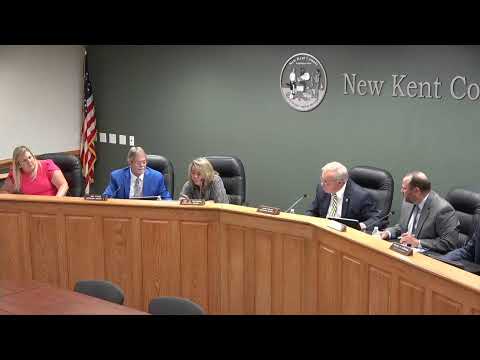
The Virginia Department of Transportation told the New Kent County Board of Supervisors on Sept. 8 that the Emmaus Church Road (Route 106) bridge replacement is being done in phases and requires temporary signals to maintain one‑lane, two‑way traffic while construction proceeds. Philip Frazier, VDOT residency representative, said the existing bridge is “structurally deficient” under the National Bridge Inspection Standards but that classification does not mean the bridge is unsafe for use.
Frazier said the project uses state of good repair (SGR) funds that allow replacement “in kind,” which constrains the new bridge to roughly the same width and prevents maintaining two traffic lanes across the structure during work. To keep traffic moving without routing a long detour, VDOT installed temporary signals to alternate one‑way traffic across the bridge; the signal prioritizes traffic serving the I‑64 ramps so queuing does not extend onto the interstate.
The VDOT official described a two‑phase construction approach: build half the bridge while traffic uses the other half, then switch traffic onto the new half and rebuild the remaining side. Each phase will take months; the initial phase was described as about seven to nine months. Much demolition on the bridge is scheduled for nighttime to avoid daytime closures on I‑64. Frazier said the temporary signal initially mis‑counted passing vehicles and produced long queues, but VDOT has adjusted detection equipment and evening operations to reduce those problems.
VDOT staff acknowledged persistent queueing that sometimes extends toward Jimmy Burrell and said the department is taking steps to mitigate backups, including converting a northbound shoulder to paved shoulder to help staging, coordinating with the sheriff’s office on enforcement, and exploring additional operational fixes where permitted. He warned that some mitigation ideas fall outside the current project’s limits of disturbance and would require further permitting or separate agreements.
Frazier explained why VDOT accelerated the bridge replacement tied to the larger I‑64 gap project: adding the bridge work to an active contract allowed the department to deliver the replacement years earlier and at lower cost than waiting for a stand‑alone project. He also explained that when a bridge’s superstructure rating falls to a “4” on the national 0–9 NBIS scale it triggers structural‑deficiency classification and eligibility for SGR funds, which is how this bridge came to the top of the schedule.
Board members and VDOT staff took questions about peak hours, safety and signage. Frazier urged drivers not to run red lights at the temporary signal and said VDOT will consider signage requests but warned signs alone do not guarantee compliance. He also noted that the divergence diamond interchange (DDI) project for the corridor is separately funded; the bridge was added to the active I‑64 contract before the DDI was funded, which is why the bridge work is being delivered on the current timeline.
The presentation included a VDOT FAQ; the board and staff were provided copies and VDOT gave contact information for construction and maintenance concerns.
Ending: VDOT did not present a formal action for the board to vote on. Officials said they will continue to monitor operations, pursue engineering fixes where permitted, and coordinate with county staff and the sheriff’s office on enforcement and signage.