Get Full Government Meeting Transcripts, Videos, & Alerts Forever!
Get email alerts on the Solid Waste Master Plan topic
No spam. Unsubscribe anytime.
Tooele County solid‑waste master plan: landfill life limited, transfer station improvements and fee changes recommended
Summary
Wayne Anderton, Tooele County’s solid‑waste director, told the County Council on Aug. 19 that the county’s landfill has roughly four years of capacity in its current active cell and another 23 years in a second phase, and recommended facility upgrades and switching from cubic‑yard visual fees to scale‑based tonnage to recover lost revenue.
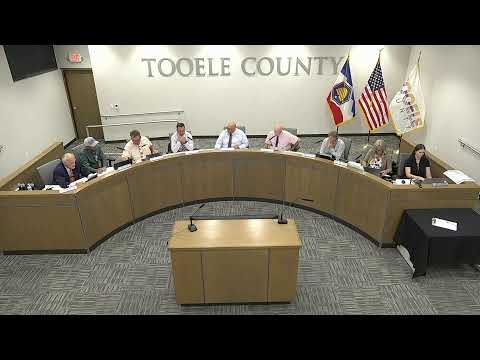
Tooele County Solid Waste Director Wayne Anderton and consultants from Forsgren & Associates presented the county’s Solid Waste Master Plan to the County Council on Aug. 19, outlining the landfill’s remaining capacity, recommended facility upgrades and a proposed change to how disposal fees are measured.
Anderton said the existing landfill report (Advanced Environmental Engineers, 2021) divides remaining capacity into two phases: phase 1 has “a little under four years left” with roughly 800,000 cubic yards of disposal volume, followed by a phase 2 with about 23 years and roughly 4.7 million cubic yards of volume. He said the current transfer station building is about 20,000 square feet with 18,500 square feet usable tipping floor and that, depending on growth, the transfer station could be outgrown within about five years unless improvements are made.
The presentation recommended several capital upgrades: shifting the landfill access road to the perimeter (estimated $437,000), constructing a new scale house with inbound and outbound scales (estimated $1.2 million), installing a new water system with a 10,000‑gallon tank and pipeline ($550,000), additional tipping‑floor improvements including a longer push wall and ramp ($1.6 million), and a new maintenance building (~$1.5 million). Anderton said the access‑road project was out to bid at the time of the meeting.
A central recommendation was changing fee measurement from visual cubic‑yard estimates to scale‑based tonnage for C&D (construction and demolition) and green‑waste material. Anderton said the county currently charges $10 per cubic yard for C&D and $7 per cubic yard for green waste and that switching to per‑ton charges could increase annual revenue by approximately $360,000, largely by reducing measurement error and lost revenue from cubic‑yard visual estimates.
Anderton and consultants also reviewed four potential transfer‑station locations (existing Bauer Road site; county‑owned Highway 36 parcel requiring additional purchase; Highway 112 county land closer to population centers; and a Rush Valley site). Each option has tradeoffs between proximity to residents and distance to the landfill. Anderton said the current site can serve the county for several more years with targeted improvements.
Council members asked about total program cost (Anderton estimated “about 4½ to 5 million” if most projects are pursued), project phasing, grant opportunities and operational impacts. Anderton said the county applied for a Solid Waste Infrastructure for Recycling (SWIFR/EPA) grant; he said a grant application of $1,330,000 was submitted and that the county expected a decision in September. Councilman Thomas and others discussed the order of priorities, with access road and water system earlier in the schedule, and a new scale house tied to fee structure changes to capture previously lost revenue.
No formal council vote occurred on capital funding or fee changes during the portion of the meeting in the transcript; council discussion focused on budgeting, fund balances and potential grant matches. County Manager Andy Welch said the solid‑waste enterprise fund is intended to break even and that fee changes and phased capital planning will be necessary if growth continues.
Anderton described short‑term operational options if capacity constraints occur — longer hours, longer on‑site storage of waste pending transport, and incremental internal reconfiguration — and emphasized planning now to avoid a crisis in roughly five years.