Get Full Government Meeting Transcripts, Videos, & Alerts Forever!
Get email alerts on the Auditor Budget Transfer topic
No spam. Unsubscribe anytime.
County attorney says transfer of purchasing duties falls within statutory authority; auditor and county recorder contest legality
Summary
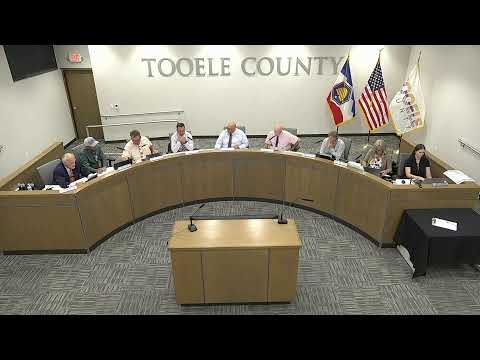
Tooele County Deputy County Attorney Nathan Harris told the County Council on Aug. 19 that his office concluded a line‑item transfer moving a purchasing agent position from the elected auditor’s office to the county manager’s department is lawful, a determination disputed by Auditor Autumn McCoy and Recorder‑Surveyor Jerry Houghton.
Tooele County Deputy County Attorney Nathan Harris told the County Council on Aug. 19 that his office reviewed state law and concluded a line‑item transfer moving a purchasing agent position out of the elected auditor’s office and into the county manager’s department is within the county’s legal authority. The disagreement over the transfer has produced public criticism, a Facebook post from Auditor Autumn McCoy and a request from county officials for clarity on statutory duties.
Harris said the council adopted ordinance 2025‑7 on July 1, 2025, which removed purchasing duties from the auditor’s enumerated responsibilities and that the manager’s July 9 email requesting transfer followed the council’s policy direction. “It is our office’s official opinion that this transfer funds falls within the bounds set forth by by the Utah legislature,” Harris said in the council chambers.
The dispute centers on which duties and supervisory powers belong to the elected auditor versus the county manager and the proper method for transferring a position and associated funds. Harris read a set of statutory citations he said define auditor and manager duties and described prior precedent where the council approved a comparable line‑item transfer in October 2024. “The county has already had precedent where we move forward in a manner that we are doing tonight,” he said, referring to a 10/23/2024 transfer that he said was later approved and signed by Auditor McCoy.
Auditor Autumn McCoy, speaking during public comment, said she did not initiate the transfer and criticized the process and substance of the public messaging by her office’s critics. “I didn’t do this. I didn’t remove duties or tasks from my office and I didn’t add this transfer to the council agenda,” McCoy said, adding she had “educated the public” and voiced concerns that the transfer would reduce internal auditing capacity and was improperly noticed on the agenda. McCoy said the amount identified for transfer is 51% of the allocated budget for the position, “roughly $17,000 for the remaining four months of this year.”
Recorder‑Surveyor Jerry Houghton told the council the proposed transfer “directly violates section 36 24,” and argued the statutory language plainly prohibits transfers of appropriations to another department. Houghton also raised broader concerns about institutional independence and pointed to state guidance reinforcing auditor independence from executive supervision, saying the transfer “undermines auditor independence, violating the fundamental separation principle.”
Harris disputed that reading of the statute and said a frequently asked questions sheet attached to McCoy’s Facebook post “erroneously states” that the cited code bars the council or manager from directing or supervising independently elected officers in all respects. He said the relevant Utah Code provisions permit the manager and council to direct departments in matters that are not the professional duties of independent elected officers and that ordinance 2025‑7 altered which duties are considered part of the auditor’s professional responsibilities.
Council members did not record a vote on the transfer during the portion of the meeting in the provided transcript. Harris identified the questions that remained open for the public—how much money is being moved, where funds are moving, oversight of audits, whether consolidation is intended, whether the county is seeking a different auditor, and whether the change affects audit scope—and answered several: the transferred amount is 51% of the position budget (~$17,000 for the remaining four months of the year); audits remain the responsibility of the elected auditor’s office; the change is not an attempt to consolidate elected offices; and the elected auditor remains an office chosen by voters.
The exchange included references to prior council action: ordinance 2025‑7 was adopted at the July 1, 2025 meeting by unanimous vote of council members present and, according to Harris, removed purchasing from the auditor’s enumerated duties. Harris also cited a line‑item transfer carried out Oct. 23, 2024 and signed by Auditor McCoy as a factual precedent.
The council did not take formal action on the transfer at the Aug. 19 meeting portion in the transcript. Several public commenters urged the council to withdraw the item and seek a collaborative solution; Harris and council members said the county attorney’s office would continue to advise officials. The dispute also prompted public questions about a separate contract for lobbying services referenced by McCoy during public comment ($450,000 total, described as $12,500 per month for three years in public remarks), which McCoy said raised transparency concerns.
What happens next was not determined in the portion of the meeting provided. The county attorney framed his presentation as the office’s neutral legal analysis. The council can revisit the agenda item, seek further legal or administrative steps, or leave the manager’s transfer request pending additional action; no final disposition was recorded in the transcript excerpts provided.