
County receives MICA briefing on 2025 state legislative outcomes: bonding, transportation, public health and human services
Get AI-powered insights, summaries, and transcripts
Subscribe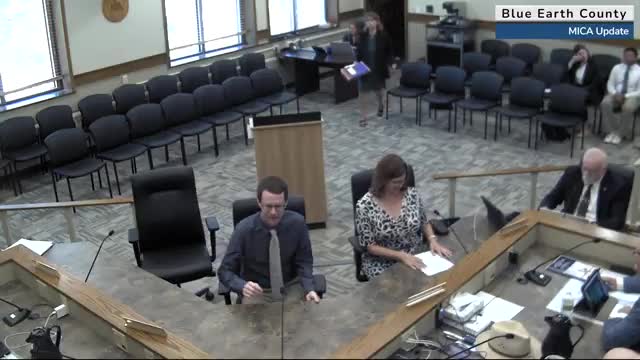
Summary
Representatives from the Minnesota Intercounty Association briefed Blue Earth County commissioners on Aug. 19 about 2025 state legislative outcomes affecting bonding, transportation, human services, public health and environmental programs.
Blue Earth County commissioners heard a multi‑topic briefing from the Minnesota Intercounty Association (MICA) and partner liaisons on Aug. 19 covering state legislative outcomes that will affect county programs and budgets. MICA's presenters summarized the 2025 session outcomes in transportation, bonding, human services, public health and environment and outlined issues for the board to track in the coming months.
Key takeaways presented by Nathan Jessen (MICA executive director), Amber Backus (transportation liaison), Nancy Solinski (public health and human services liaison), Rachel Sysojcick (environmental liaison) and others included:
- Bonding and local infrastructure: A bonding bill passed that included funding allocations MICA highlighted for local priorities: roughly $42,000,000 for the Local Road Improvement (LRIP) program, $20,000,000 for local bridges, and $5,000,000 for local government road wetland replacement (figures as presented). MICA said the wetland replacement funds will support projects in regional Wetland Bank Area 9.
- Transportation: The final transportation bill reduced some dedicated revenues and slowed a sales-tax dedication for trunk highways, but provided new general‑fund appropriations for certain programs; MnDOT and county staff will need to adjust plans to reflect reduced trunk-highway and county-state-aid forecasts. MICA noted a federal/EV fee change and that local reimbursement for certain motor-vehicle transactions was added.
- Human services and public health: The session included $35,000,000 for SSIS (case‑management system) modernization plus $10,000,000 carried forward, creating $45,000,000 to match federal funds; bonding included $55,000,000 to expand AMRTC capacity and the human‑services bill funded capacity and operating dollars to support behavioral‑health treatment beds. Solinski said changes passed to allow longer reassessment intervals for some MA-related assessments and other operational flexibilities for casework.
- Environment and solid waste: Legacy clean water funding was largely adopted as recommended; aquatic invasive species aid was cut approximately 50 percent in the enacted package. MICA noted progress on producer-responsibility packaging legislation passed in 2024 and continued discussions on batteries and electronics stewardship that did not pass in 2025.
The briefing was informational; commissioners asked clarifying questions about local impacts, timelines and funding timing. Presenters emphasized that some items will not affect county budgets until 2027 and that additional implementation work groups and rulemaking will follow. Staff said they would track grants, TIP updates, and program-rule workgroups and return with recommendations when state actions require local responses.