
Board approves UDO amendment removing Environmental Health review requirement for rural family occupations
Get AI-powered insights, summaries, and transcripts
Subscribe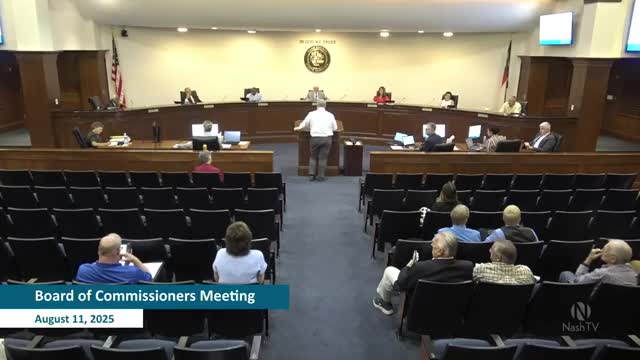
Summary
Nash County commissioners voted Aug. 11 to amend the Unified Development Ordinance to remove a requirement that the county Environmental Health division provide written evaluations of noise, air emissions, dust and odors for rural family occupation special‑use permits.
NASHVILLE, N.C. — Nash County commissioners on Aug. 11 approved a targeted text amendment to the county’s Unified Development Ordinance (UDO) that removes a requirement the County’s Environmental Health division prepare a written evaluation of non‑septic environmental impacts for “rural family occupation” special‑use permit requests.
Planning Director Adam Tyson told commissioners the UDO previously required Environmental Health to determine potential impacts “with respect to excessive noise, dust, air emissions, odors and surface or groundwater discharge.” Environmental Health advised staff it lacked the authority and technical expertise to evaluate broad air and noise impacts, Tyson said, and that the requirement was therefore inappropriate to ask of the county health staff.
The amendment removes that specific line from the development standards but does not prevent the Board of Adjustment from considering noise, emissions or other environmental impacts when acting on a special‑use permit; those concerns can be addressed under the board’s duties to ensure proposed uses will not endanger public health or substantially injure adjoining property values and that projects conform to the comprehensive plan.
Tyson said the text change was prompted by a pending special‑use permit (a proposed home‑based gas‑contractor business) for which Environmental Health could not complete the written review required by the ordinance. The Board of Adjustment postponed that quasi‑judicial hearing and directed staff to pursue the text amendment; the Planning Board later recommended approval of the change.
Commissioner Leggett and others said they supported the amendment as a narrow, technical correction that clarified the division of responsibility between planning and Environmental Health staff. Commissioner Howell asked that the forthcoming broader UDO update consider explicit staff pathways for when technical or state expertise is needed; Tyson confirmed staff would consult state agencies (for example, the Department of Environmental Quality) where appropriate.
Why it matters: The change narrows a procedural requirement that staff said Environmental Health could not meet, while preserving the Board of Adjustment’s authority to evaluate environmental concerns. The decision is procedural rather than discretionary regarding particular uses and was framed as a housekeeping change to align the UDO with operational realities.
What’s next: The specific special‑use permit referenced in staff’s report (a rural family occupation request by Gas Pro LLC) will resume consideration by the Board of Adjustment at its next meeting after the UDO amendment takes effect.