
Henry County holds second millage hearing as officials defend 15.733 proposed rate
Get AI-powered insights, summaries, and transcripts
Subscribe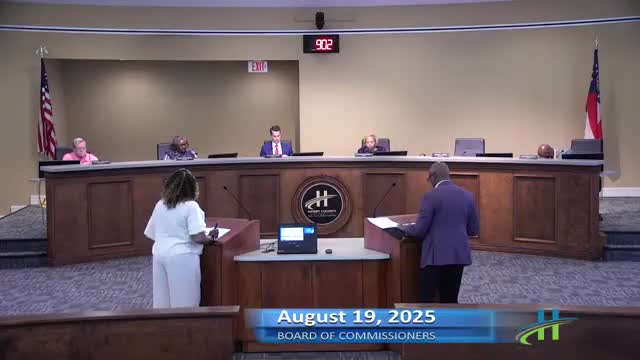
Summary
At a public hearing Aug. 19, Henry County officials reviewed the FY26 budget and explained a proposed county millage rate of 15.733 mills, described exemptions that limit tax increases for many homeowners and said final adoption is scheduled for the board's meeting tonight at 6:30 p.m.
Henry County held the second of three public hearings on Aug. 19 on a proposed county millage rate of 15.733 mills, with Tax Commissioner Michael Harris and Budget Director Bonita Campbell explaining how the rate and exemptions affect homeowners and answering procedural questions ahead of a final adoption vote scheduled for 6:30 p.m. the same evening.
Why it matters: The millage rate helps fund the county’s portion of local property taxes and, together with school and city millage, determines most residents’ tax bills. County staff said the FY26 budget relies on property-tax revenue to support public-safety staffing, road work and judicial expansion and that more than half of total property-tax dollars go to schools.
The county’s adopted FY26 general-fund and special-service-district budget totals $287,797,000, a $28,100,000 (10.8%) increase over the prior year, Budget Director Bonita Campbell said. She told the board staff developed the budget through commissioner one-on-ones, leadership meetings, two budget workshops and two public hearings and that the adopted budget was built without using fund balance.
Tax Commissioner Michael Harris gave a plain-language overview of how millage works and worked through examples. He explained assessed value equals 40% of fair-market value and that basic homestead (L1) exemptions and a separate frozen-exemption provision can significantly reduce a homeowner’s taxable value. "Again, as stated, this is the second of 3 public hearings regarding the setting of the millage for this year," Harris said.
Using the county’s 15.733-mill rate, Harris illustrated typical tax calculations. For a homesteaded property with a $300,000 fair-market value, the assessed value is $120,000; the standard $15,000 homestead exemption reduces the taxable value to $105,000, which at 15.733 mills produces a county tax of about $1,651.97. A non‑homesteaded $300,000 property would be taxed on $120,000 and owe about $1,887.96 in county tax, a difference of roughly $236.
Harris described Henry County’s so-called frozen exemption, enacted in February 2004, which locks the county portion of a homesteaded property’s taxable value at the value in the year the owner applied for the freeze. He said the freeze applies to the primary residence and up to five acres, automatically renews while the homeowner occupies the residence and prevents bills from rising with later market appreciation. Harris said the county’s frozen provision generally produces a lower effective increase for long-standing homesteads than the new statewide option created by House Bill 581.
House Bill 581, passed earlier this year, allows jurisdictions to offer a CPI-based “floating” exemption option. Harris said state law requires counties that opted in to compare, parcel by parcel, whether the county’s frozen provision or the HB581 floating option benefits each taxpayer more; his office is running that analysis. "We also have to run an analysis to determine which is more beneficial for the resident, the current frozen provision that we have in place right now or this new float option that the county did opt in for," he said.
Harris told the board the digest process has been more complex this year because of HB581, and that the county has sought clarification from the Georgia Department of Revenue and, for unresolved questions, the state Attorney General’s office. He said county staff and vendors have been working extended hours and that the county aims to mail tax bills by Sept. 1 and meet the customary Nov. 16 due date, though he cautioned the deadline could change if state guidance or the digest timeline shifts.
Harris outlined how tax bills are allocated: roughly 50% of property-tax dollars go to school maintenance and operations (the Henry County School Board reduced its millage from 20 to 19.8 mills at a recent meeting), 5% to school bonds (about 2 mills), and the remaining roughly 40% funded by the county’s proposed 15.733 mills covers county services. He also reported city millage positions: Stockbridge remained at 3.77 mills, McDonough held at 3.033, Hampton reduced to 4.995, and Locust Grove adopted a 4.087 city millage paired with a full city exemption for residents.
The hearing drew no public speakers; the chair closed the hearing after asking for comments. Harris and Campbell answered board questions and reiterated that tonight’s meeting will include the final adoption vote on the county millage rate. No formal vote on the millage occurred during the Aug. 19 hearing.
The county’s immediate next steps are to complete the parcel-by-parcel comparison required under HB581, finalize the digest with the State Department of Revenue and proceed to the board’s adoption vote at the scheduled public meeting that evening.