Get Full Government Meeting Transcripts, Videos, & Alerts Forever!
Get email alerts on the Community Benefits Program topic
No spam. Unsubscribe anytime.
Planning commission forwards community benefits program to council with clarifying edits and timeline extension
Summary
The Arcata Planning Commission voted Aug. 12 to recommend a community benefits program to the City Council after agreeing to consolidate several benefit options and extend an eligibility date for incentive points to Dec. 31, 2027.
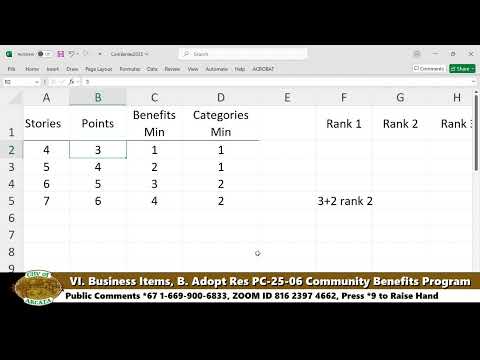
The Arcata Planning Commission on Aug. 12 voted to forward Resolution PC 25-06 to City Council recommending adoption of a community benefits program and its point‑scoring framework, with several revisions and clarifications requested by the commission.
Key decisions recorded at the meeting include a proposal to consolidate several related benefit options into one flexible option that would require a developer to commit a minimum of 1,500 square feet of space or 1.5% of a project’s cost to one of a short list of community uses (examples discussed: child care, senior services, publicly accessible native arts/cultural space, or on‑site public open space). Commissioners also supported raising some items that had been listed at 0.5% of project cost to 1.5% and agreed to level point values so that the same dollar amount yields comparable points regardless of the benefit chosen. The commission extended the deadline for eligibility for a rapid housing production application to Dec. 31, 2027.
Staff told the commission the program is intended to provide predictable alternatives for developers seeking incentives while reflecting community priorities derived from prior engagement. Staff said some benefits could be delivered on‑site (for example, committed floor area for a daycare) while others might be delivered via an in‑lieu fund; staff also noted that new financial mechanisms and administrative setup would be required if the city uses funds for community benefits rather than on‑site delivery. Staff indicated the commission’s recommendation could go to City Council in September and, if approved, the program could be launched by early 2026.
Public comment: one commenter urged the commission to include an explicit community benefit for the arts — specifically, a fund to support arts activities and artist support in the Creamery District and other parts of the city. The commenter said local arts work was central to prior gateway planning processes and asked that arts funding be restored or explicitly available under the benefits program. Commissioners discussed that an in‑lieu fund could cover arts programming while the consolidated minimum‑square‑foot option could address space needs for community uses.
Debate highlights and rationale: commissioners debated fund‑based delivery versus on‑site commitments. Some members argued fund approaches provide flexibility and the ability to allocate funds to community priorities over time; others said on‑site delivery can ensure each dollar is spent directly on the benefit and reduces administrative overhead. Commissioners also questioned the 20‑year minimum proposed for bus passes, noting it may be a long commitment for some developers; staff and commissioners referenced a 20‑year bus pass arrangement used on an affordable housing project in Eureka as a precedent. Several commissioners emphasized the need to test the program in practice and adjust point values and thresholds after real projects use the incentives.
Formal action and next steps: a commissioner moved to recommend PC 25-06 to City Council with the changes discussed (consolidation of items, raising selected 0.5% items to 1.5%, leveling point values, and extending the rapid housing application date to Dec. 31, 2027); the motion was seconded and the commission voted aye. Staff said it will prepare the revised language for submittal to Council and noted the city would need to set up any new fund accounts and administrative procedures before fund‑based benefits could be accepted by applicants.
Why it matters: the community benefits program will shape what developers can offer to access incentives and how the city prioritizes public benefits such as affordable housing, child care, arts and cultural space, transportation benefits, and environmental mitigation. The commission’s changes aim to balance flexibility for developers with minimum standards for community benefit delivery.