Get Full Government Meeting Transcripts, Videos, & Alerts Forever!
Get email alerts on the Licensure Portability topic
No spam. Unsubscribe anytime.
FSMB urges state boards to use supervisory pathways, data collection for internationally trained physicians
Summary
The Federation of State Medical Boards outlined recommended guardrails for state-level pathways allowing internationally trained physicians to practice in U.S. jurisdictions, stressing provisional licensure, employer oversight and standardized data collection.
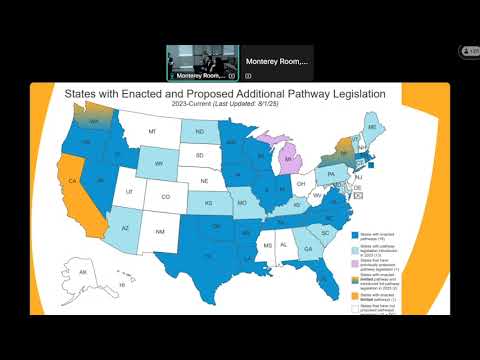
At a Medical Board of California meeting in San Diego and via Webex, the Federation of State Medical Boards (FSMB) presented recommendations for state pathways to license internationally trained physicians, emphasizing employer oversight and provisional supervision. FSMB President and CEO Henk Chowdhury and FSMB Chief of Staff Andrea Chacon told the board that 18 states have passed laws enabling such pathways but that only two physicians were enrolled nationwide so far.
Why it matters: State licensing boards are being asked to expand the medical workforce while balancing patient safety, supervision capacity and immigration uncertainty. FSMB’s guidance focuses on what licensing boards and employers should require so provisional pathways do not create gaps in oversight.
The FSMB presentation said state boards should retain rule-making authority to design the details of pathways and that employers sponsoring applicants should be organizations with experience in oversight — for example hospitals with training programs or federally qualified health centers, not solo practices. Chowdhury told the board that “legislators can come up with the sort of 5,000-foot or 10,000-foot guidance, and that's fine. But it should be up to the state licensing boards to do the details.”
Chacon described expected elements of the provisional period: a formative needs assessment, longitudinal and multimodal evaluation of the physician across the six general competencies, and supervision tailored to the trainee’s competence. “At the end of the supervisory period, we want to make sure that this physician is able to demonstrate that they are able to engage in independent and unsupervised practice,” Chacon said.
FSMB’s nine-point eligibility overview includes graduation from a recognized medical school, evidence of postgraduate training or demonstrated experience, current licensure in another country, limits on time out of practice, provisional licensure with supervised practice and final assessment before granting an unrestricted license. The commission also recommended that states collect and report data on applicants and outcomes so practices that work — and those that do not — can be shared.
Board members raised implementation questions. Dr. Felix Yip and others said immigration and visa constraints are often the principal barrier to recruiting physicians trained abroad; Chowdhury agreed that federal immigration policy and visa availability are major uncertainties. Dr. Thorpe and others asked how states and the board would monitor employer oversight, compensation and workloads; FSMB presenters said those operational details are often left to employer standards and state boards’ rule-making but flagged them as areas for further attention.
FSMB staff noted implementation challenges observed in early-adopter states: small candidate pipelines, uncertainty among state boards about application processing, unclear funding streams for supervision and the difficulty of assessing equivalence of foreign postgraduate training. Chowdhury said the advisory commission is not endorsing the pathway as the only solution but offering guidance because many states are pursuing it.
The presentation closed with a reminder that next steps include publication of FSMB guidance and a toolkit for boards and employers. No formal board action was taken; the item was presented for information and discussion.