
Residents raise flooding, setback and safety concerns at Salem Hills conceptual plan
Get AI-powered insights, summaries, and transcripts
Subscribe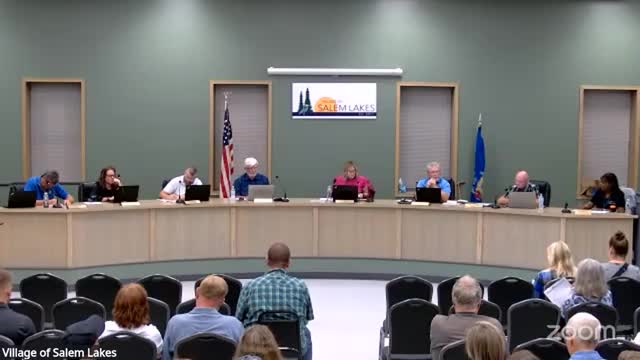
Summary
Dozens of residents told the Village of Salem Lakes Village Board on Aug. 19 they oppose a conceptual 11‑lot plan for the Salem Hills addition by Behr Development, chiefly over a proposed access road that neighbors say would sit too close to existing homes and could worsen flooding.
Dozens of residents told the Village of Salem Lakes Village Board on Aug. 19 they oppose a conceptual 11‑lot plan for the Salem Hills addition by Behr Development, chiefly over a proposed access road that neighbors say would sit too close to existing homes and could worsen flooding. The concerns came during the board’s public‑comment period and in a subsequent concept presentation by developer Jonah Hetland. Residents said the proposed private road would run between existing lots, expose home windows and wells to headlights and runoff, and bring construction‑period and long‑term traffic that would change neighborhood character. The developer, Jonah Hetland of Behr Development, said the 40‑acre parcel abuts the existing Salem Hills subdivision and the concept shows an average lot size of about 3.5 acres (the smallest about 1.5 acres and the largest about 12 acres). Ten lots would take access from a new private road connecting through the existing subdivision; one large lot would use an existing driveway onto Highway 50. Hetland said stormwater detention was not engineered at the concept stage and repeated that the plan would be refined if the board gave direction. Why it matters: residents said the proposed road would place an access corridor immediately behind or beside houses that were purchased for privacy and rural character, and they described recurring flooding and drainage problems they say earlier development created. Some residents asked the board to require access from Highway 50 instead, to preserve tree lines, and to hold developers to construction‑hour limits. What the board and staff asked for: board members and staff asked Behr to 1) test the existing setback and zoning requirements the residents cited, 2) have the fire chief review emergency access and road cross‑section details, 3) confirm possible WisDOT (Wisconsin Department of Transportation) constraints for any Highway 50 access, and 4) examine whether an existing outlot shown on the original Salem Hills plat (parcel cited in the meeting as tax parcel 0540344) functions as the subdivision’s stormwater detention and whether that lot could be used or reconfigured as a neighborhood park. Hetland said he would return with engineering and platting details if the board’s feedback was positive. What residents said: during public comment, residents described specific impacts: one resident said her home would be about 17 feet from the proposed road and cited "section 4‑90‑31.3" of the village code as requiring a 30‑foot setback in R2 zoning; another said prior tree thinning on the property increased runoff and reduced wildlife; others described regular yard and basement flooding and said heavier roadway traffic would endanger children who currently play in the street. Developer responses and constraints: Hetland said the proposed private road would be built and maintained by a homeowners association and described a small wetland impact where the private road would cross; he also said the largest lot would retain a separate driveway to Highway 50. He noted that the concept would require rezoning of a small PR‑1 (park) area back to R2 because the prior, larger subdivision layout had designated a small park that would now fall inside a buildable lot. Hetland said a public‑road connection to Highway 50 would be expensive and likely not feasible for the scale of this proposal, but that the existing driveway on the 12‑acre lot could be used for that single lot. Next steps: the board did not take final action. Staff were asked to: verify the recorded plat and ownership and confirm whether the identified outlot was the original subdivision stormwater area; have the fire chief review the proposed private road cross sections and turning radii; and flag any formal permitting or rezoning requirements that would be triggered. Hetland said he would pursue engineering only after receiving clearer direction. Ending: The board and developer framed the presentation as a concept only; the village’s staff reiterated that any formal plat, rezoning or public‑hearing steps would follow planning‑commission review and a public‑hearing process.