Get Full Government Meeting Transcripts, Videos, & Alerts Forever!
Get email alerts on the Transportation Governance topic
No spam. Unsubscribe anytime.
Metro legal outlines roles and limits of NDOT, Traffic & Parking, BPAC and council committee
Summary
Metro Legal and council special counsel summarized statutory and charter authorities, membership and legal limits for the Department of Transportation and Multimodal Infrastructure (NDOT), the Traffic and Parking Commission, the Bicycle and Pedestrian Advisory Commission and the Metropolitan Council's Transportation & Infrastructure Committee.
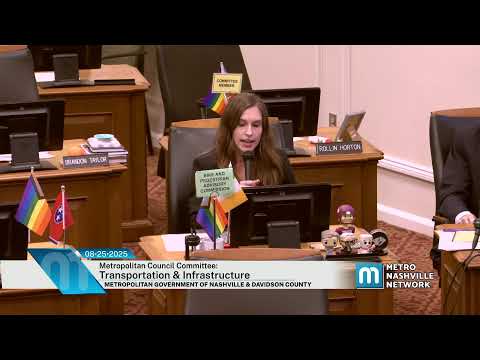
Metro Legal and the council's special counsel told a joint meeting of council members and advisory bodies that the city's transportation responsibilities are split among distinct entities with different creation mechanisms, membership rules and legal limits. The presentation outlined what each entity may and may not do and stressed compliance with the Metropolitan Charter, the Metropolitan Code of Laws and open-government statutes.
The overview came from Anne Mickelson, an attorney with Metro Legal, and Margaret Darby, director and special counsel to the Metropolitan Council. Mickelson told the group the Department of Transportation and Multimodal Infrastructure (NDOT) has broad duties under the Metropolitan Charter, including design, construction, maintenance, repair and management of public ways and related structures; preparation of plans and reports if requested by council or the mayor; supervision of department contracts; and administration of permits and licenses that affect the right-of-way.
Mickelson said the traffic and parking commission acts in a legislative capacity with enumerated powers over traffic regulation within the Metro right-of-way. Her description included membership and powers: the commission has nine members (the chief of police, one council member and seven mayoral appointees confirmed by council) and may adopt rules about parking limits and prohibitions, stop sign and through-street designations, signal controls, vehicle restrictions, speed zones and management of parking meters and public parking garages.
The Bicycle and Pedestrian Advisory Commission (BPAC) is an advisory body created by ordinance. Mickelson said BPAC has roughly eleven members drawn from community groups, academics, disability advocates, transportation professionals, senior advocacy groups and active users such as local cycling and walking clubs; NDOT and other departments have ex officio designees. BPAC's role, she said, is to review and recommend on plans, to coordinate with other commissions and to advise departments on bicycling, walking and micromobility.
Darby summarized the role of the Metropolitan Council's Transportation and Infrastructure Committee and how the body handles legislation. The committee is a standing committee under council rules, with membership and chairmanship appointed by the vice mayor for year-long terms. Subject-matter legislation related to infrastructure, traffic, parking, water, sewer and related utilities is referred to that committee; ordinances are considered on second reading there and resolutions are considered at the meeting where they are introduced or immediately before council action. Darby also reminded attendees the committee must follow the Open Meetings Act and the Public Records Act.
Both counsel emphasized legal limitations that apply to decisionmaking: federal and state transportation law, the municipal charter and code, and the need for material evidence in judicial review of commission decisions. Mickelson noted certiorari review in state courts requires decisions be supported by relevant material evidence and not be arbitrary; opinions and fears alone are not sufficient.
Why it matters: members of advisory commissions, commissioners and council staff at the meeting said clearer understanding of who does what could reduce duplication and accelerate safety work. The legal briefing was intended as a baseline so the City's advisory and legislative bodies could better coordinate on design, quick-build safety measures and consultation with state agencies.
The presentation included procedural details about how ordinances, resolutions and departmental requests are routed, and counsel said members and staff should consult Metro Legal or special counsel for questions about meetings, records or appeals.