Get Full Government Meeting Transcripts, Videos, & Alerts Forever!
Get email alerts on the Parking Regulation topic
No spam. Unsubscribe anytime.
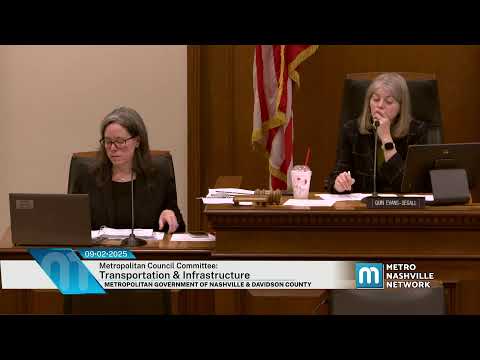
Committee debates street-parking limit for trailers and trucks; substitute vote ends 5–5
Summary
Committee considered BL2025-956 to amend chapter 12.4 on abandoned vehicles and street/alley parking; substitute raised and adopted changes on weight and emergency passage but the final committee tally on the bill as substituted was reported as a 5–5 split, leaving no clear committee action.
The Transportation Infrastructure Committee on Sept. 2 reviewed BL2025-956, an ordinance proposing changes to chapter 12.4 of the Metropolitan Code of Laws addressing abandoned vehicles and restrictions on street and alley parking. Committee discussion focused on the ordinance's effect on trailers, contractors, food trucks and emergency access; the substitute changed the gross-weight threshold and removed school buses from the prohibition.
Sponsor Councilmember Ellis moved the bill and presented a substitute that, based on committee remarks, made these principal changes: - removed school buses from the prohibition language; - raised the gross-weight threshold referenced in the text from 8,800 pounds to 10,000 pounds (aligning with a class-3 vehicle threshold cited by a committee member); - added a 12-foot clearance emphasis so emergency vehicles retain passage on neighborhood streets; and - included exemptions or clarifications for active loading/unloading in certain circumstances as discussed by special counsel.
Councilmember Parker raised a concrete example: using a 5-by-8 trailer for a one-day home-repair project on a street without alleys or driveways. Director/Special Counsel Darby (Metro Legal) told the committee that if a trailer is present while an owner is actively loading or unloading, "then, no, you would not be in violation." Darby added that if a trailer is parked on the public right of way after loading/unloading is complete, it would likely be a violation unless otherwise permitted.
Matt Purvis, council liaison for the Department of Transportation and Multimodal Infrastructure, explained administrative options for restricting parking on narrow residential streets: the department has authority to restrict parking administratively on streets under 30 feet wide; streets wider than 30 feet may require Traffic and Parking Commission action.
Community and operational concerns: multiple councilmembers asked whether a countywide ordinance is the right tool versus targeted restrictions by Traffic and Parking or area-specific code changes. Councilmember Benedict/Benedek (name varies slightly in the transcript) urged referral to the Traffic and Parking Commission; the sponsor signaled intent to refer the bill to that commission and to defer on the council floor until Oct. 21 to gather feedback (Traffic and Parking Commission meets Oct. 13).
Vote and outcome: committee attempted to vote on the substitute and then the bill as substituted. Voting was complicated by missed raised hands and counting; the final tally announced in committee was 5 in favor, 5 opposed, with at least one member not voting. The chair did not announce the ordinance as approved. Because the committee did not record the measure as passing, the committee-recorded outcome for the meeting is a split vote (5–5) and no clear committee approval recorded on Sept. 2.
Why it matters: the ordinance would change what types of vehicles and trailers can park on neighborhood streets and could affect contractors, small business operators (including food trucks), homeowners doing short-term work, and street-clearing operations during winter. Committee members emphasized protecting emergency access and avoiding unintended impacts on livelihoods that rely on street parking.
Next steps: the sponsor indicated plans to seek Traffic and Parking Commission input and consider a floor deferral until Oct. 21; the ordinance's future depends on changes made after that review and on a definitive committee or council vote.