Get Full Government Meeting Transcripts, Videos, & Alerts Forever!
Get email alerts on the Transportation Regulation topic
No spam. Unsubscribe anytime.
Committee approves separate permit class for seated sightseeing vehicles, establishes 4–6 p.m. permit window
Summary
The Transportation Infrastructure Committee approved a substitute for BL2025-954 to create a separate chapter and permitting framework for seated sightseeing vehicles (SSVs), including a new 4–6 p.m. permit that requires traffic study and fixed routes; Metro Legal said the separate framework has a defensible rational basis.
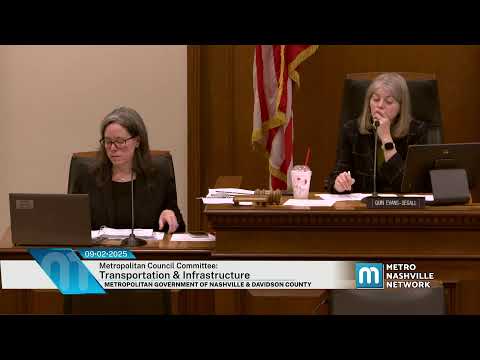
The Transportation Infrastructure Committee on Sept. 2 approved a substitute to BL2025-954 to create a standalone regulatory chapter for seated sightseeing vehicles, a change sponsors said will distinguish tour-type vehicles from party buses and allow a limited 4 p.m. to 6 p.m. downtown operating permit that requires a traffic study.
The bill, sponsored in committee by Councilmember Coop (listed in committee materials as Coop/Coopin), passed the committee vote as substituted, recorded as 11 in favor, 0 opposed. Committee members said the substitute tightens rules on routes, stops and alcohol prohibitions for seated sightseeing vehicles.
Councilmember Coop, the lead sponsor, said the substitute separates sightseeing vehicles from the broader entertainment-vehicle chapter. "This is a bill that I've been hard at work on ... the seated sightseeing vehicles don't serve alcohol," Coop said, adding the new permit would require proof that vehicles can "move the speed of traffic" and operate on an approved fixed route.
Why it matters: Nashville's tourism fleet has diversified, and operators and regulators said treating tour operators and party buses identically created enforcement confusion and inconsistent customer expectations. Supporters told the committee that a separate chapter will allow clearer enforcement without changing the overall number of permitted vehicles.
What the substitute does: according to the sponsor and presenters, the substitute - creates a new code chapter for seated sightseeing vehicles (SSVs); - specifies that SSVs must operate on fixed routes, keep passengers seated at all times and prohibit alcohol on board; - establishes a 4 p.m.–6 p.m. permit for limited downtown operation that requires a traffic study and proof that a vehicle can operate at the speed of traffic during that period; and - requires permit holders who want existing sightseeing stops reviewed to present a list to the Department of Transportation and Multimodal Infrastructure, which will recommend approvals or denials to the Traffic and Parking Commission.
Chris Madam, who identified himself as a representative of Old Town Trolley Tours, spoke during public comment in support of the bill: "We're speaking tonight in support of BL2025-954 ... We operate on fixed routes, require all passengers to be seated at all times, prohibit alcohol on board," he said, urging committee members to approve the measure.
Legal review and transition: Metro Legal and the sponsor told the committee the city looked at state preemption and related risks. "Our office and Metro Legal has taken a look at this bill and the substitute," a Metro Legal speaker said, and they believe there is a defensible rational basis for creating a separate framework. The sponsor said current ETV (entertainment transportation vehicle) permit holders would be allowed to "opt in" to the new SSV permit during the existing permit year rather than being required to forfeit an active permit; at permit-year-end the older permit pathway would expire and operators would have to obtain the new permit if they wished to continue under the SSV rules.
Stops and enforcement: the substitute requires operators that have stops to submit them for review within 30 days of enactment; the Department of Transportation will review and forward recommendations to the Traffic and Parking Commission, which will approve or disapprove specific stops. The sponsor said the change is intended to move stop determination into the Traffic and Parking Commission's authority.
Committee reaction and next steps: committee members including Councilmembers Spain, Allen and Cash asked questions about legal defensibility, transition language, and how loading/unloading locations would be designated. The sponsor said further discussion could occur on the council floor and that she might seek a floor deferral, but moved the substitute through the committee for consideration. The bill will next appear before full council where additional debate, amendment or deferral are possible.
Additional context: the committee framed the change as regulatory clarity rather than an expansion of permitted vehicles. The substitute includes traffic-study and operational requirements aimed at limiting the new 4–6 p.m. downtown permit to vehicles that can move with general traffic flow and not contribute to congestion.