Get Full Government Meeting Transcripts, Videos, & Alerts Forever!
Get email alerts on the Land Use Zoning topic
No spam. Unsubscribe anytime.
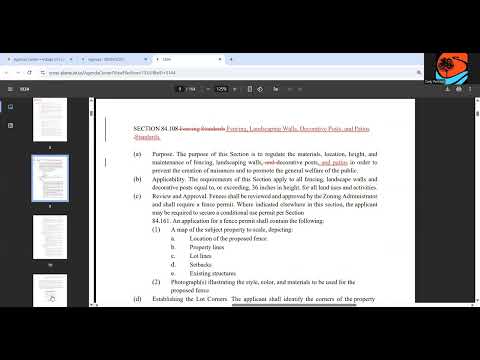
Plan commission moves to reduce patio setback to 5 feet, renames section to include retaining walls and decorative posts
Summary
The Cross Plains Plan Commission on Aug. 4 voted to allow patios as close as 5 feet to side and rear property lines and to retitle section 84.108 so it explicitly covers fencing, retaining walls and decorative posts.
The Cross Plains Plan Commission on Aug. 4 voted to revise local zoning language so patios may be built up to 5 feet from side and rear lot lines and to change the title of section 84.108 to explicitly include fencing, retaining walls and decorative posts.
The change follows a homeowner appeal to the zoning board of appeals that was denied 4–1 and a staff recommendation to revise the ordinance so similar cases can be addressed through the code rather than individual appeals. Carly (planning staff) presented background and said the homeowners had pursued an appeal after the current 10-foot setback made a proposed patio infeasible.
The move matters to homeowners on small corner lots who said current rules leave them with little usable outdoor space. Ben, filling in for Sonia at Van de Waal Engineering, told commissioners he had reviewed a draft memo and “identified a couple of things that could be a concern, and how we could potentially address it.” That memo suggested alternatives including tying patio setbacks to pavement setbacks or adopting a uniform 5-foot pavement setback to reduce run‑off and site-specific complications.
Commissioner Kevin (last name not specified in the transcript) raised procedural concerns about changing the code to accommodate a single exception: “Similarly, changing code, making a big change for an exception seems strange.” Commissioner Seth, identified in the meeting as a traffic engineer and frequent technical contributor, and others discussed tradeoffs between leaving patios as accessory structures (which in some zoning districts carry a 10-foot rear setback) and moving patios into the landscaping/fence subsection to allow a smaller setback in many districts.
Commissioners also debated stormwater and neighboring impacts. One participant warned that impervious surface materials can lose permeability without maintenance and that the village cannot easily enforce long‑term maintenance of permeable pavement. Another commissioner proposed that patios built inside a reduced setback could be required to use pervious materials or include drainage measures; staff noted the village’s zoning code already requires that changes not direct water onto a neighbor’s property.
After discussion, a commissioner moved to change the heading of section 84.108 to include “fencing, landscape walls, decorative posts” and to adopt revised language in section 84.65(j)(1) so patios ‘‘shall be at least 5 feet from the rear and side yards’’ and to keep the engineering-drafted language for other subsections. The motion was seconded and approved by voice vote with no recorded opposition.
The change will require staff to update the ordinance text and the zoning table where accessory structures and pavement setbacks are defined to ensure consistency across zoning districts. Commissioners asked staff to draft the precise amendments for formal adoption and publication.
The zoning board of appeals’ earlier 4–1 denial and the number of prior informal violations in the village were cited during the discussion and factored into commissioners’ preference for making a clear code change rather than deciding future cases ad hoc.
The commission closed the discussion by directing staff to prepare revised ordinance language for formal adoption and to return the edited text for review at a future meeting.