
SACS presents four‑phase strategic plan to counter enrollment decline; intra‑ and inter‑district transfers, signature programs proposed
Get AI-powered insights, summaries, and transcripts
Subscribe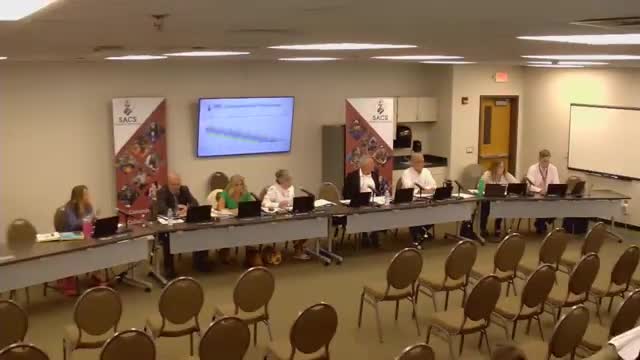
Summary
District staff told the board enrollment peaked in 2021–22 and has declined since; a four‑phase plan would first seek resident transfers, then nonresident transfers, and later expand CTE and elementary signature programming. Board set a community forum for Sept. 8 and discussed transportation, transfer criteria and potential fiscal impacts.
Southwest Allen County Schools officials told the school board that enrollment peaked in the 2021–22 and 2022–23 school years and has declined since, and they proposed a four‑phase, board‑driven strategic plan to position the district as a “district of choice.” The plan would first open limited intra‑district (resident) transfers, then allow controlled inter‑district (nonresident) transfers, and later expand career and technical education (CTE) center programming and pilot “signature” elementary programs.
Why it matters: State tuition support and foundation funding follow each enrolled student; presenters said the district receives roughly $7,200 per student and that sustained enrollment losses would reduce resources available for programs and staffing.
At the meeting, Dr. St. John framed the plan as a response to demographic shifts and growing school choice in the area. “What I mean by that is both expanding choice and embracing choice,” he said, summarizing the plan’s aim to measure success by stronger enrollment and “a clear plan for expanding opportunities.” Board members pressed staff on the consequences of doing nothing: “If we sit on our hands and let this trend play out, what happens?” asked board member Josh Copley. Dr. St. John said projections showed the district could be down about 1,000 students within five years in a conservative scenario and reminded the board that “resources follow the student.”
Key details of the four phases presented - Phase 1: Outreach and transparency. Staff will hold public engagement (staff scheduled a community forum for Sept. 8, 7–8 p.m., in the Homestead High School gray box) and publish a plan Q&A on the district website within about 60 days. - Phase 2: Intra‑district transfers (resident transfers). Policy updates could be drafted this fall; capacity by grade and school would be determined in early 2026, with transfer applications and a lottery if demand exceeds seats (timeline discussed: capacities communicated in February 2026 and a March 2026 lottery and notification). - Phase 3: Inter‑district transfers (nonresidents). If capacity remains after resident transfers, staff would open limited nonresident seats for the 2026–27 school year, with policy updates and an April/May 2026 lottery and notifications if needed. Transportation for both intra‑ and inter‑district transfers would be the families’ responsibility if the assigned school is outside their attendance area. - Phase 4: Program expansion. Staff would explore CTE center offerings tied to community workforce needs and pilot elementary “signature” programs (examples cited: dual language immersion, fine arts, STEM, environmental/nature‑based instruction). Planning and staffing could begin in 2026–27 for partial launches in 2027–28.
Staff said transfer approvals would be subject to criteria the board would codify in policy — specifically behavior and attendance standards. “Indiana code, and actually some existing SACS policy for interdistrict transfer includes criteria related for student behavior and attendance,” Dr. St. John said; staff proposed that transfers be revocable if students no longer meet those standards.
CTE and program selection: Ms. Kleber, who described current work with middle schools and community partners, said programming decisions will be driven by student interest data and local workforce needs and cautioned against unnecessary duplication with neighboring CTE centers. She gave cosmetology as an example of unmet local demand: “We turn our own students away because we only have two seats,” she said, and noted other districts have expressed interest in partnering.
Demographic and enrollment context: Mrs. Libby presented slides showing a district‑wide peak in 2021–22, followed by steady declines and a long‑term demographic shift toward an older household profile within many elementary attendance boundaries. She reported the district has lost roughly 540 students over the last four years and that ESACS (virtual) enrollment is counted separately; she added an example that adding ESACS pupils back to some totals would raise Homestead High’s figure to 2,463.
Board concerns and next steps: Board members asked practical questions about capacity calculations, grade levels to prioritize, guarantee of seats for transfer students through graduation, and how programming would be selected. Dr. St. John recommended guarantees be conditional on continued adherence to transfer criteria: once admitted, students would retain a seat “through graduation pending that that student would continue to meet the criteria for being a transfer.” The board did not vote on any policy changes; staff were directed to continue engagement, post materials online and return to the board as policy language is drafted.
The district announced the Sept. 8 community forum and that transfer‑policy proposals, capacity estimates and proposed lottery procedures would be presented to the board before any openings were offered.