
Ellensburg outlines accessory dwelling unit rules: size, zones, setbacks
Get AI-powered insights, summaries, and transcripts
Subscribe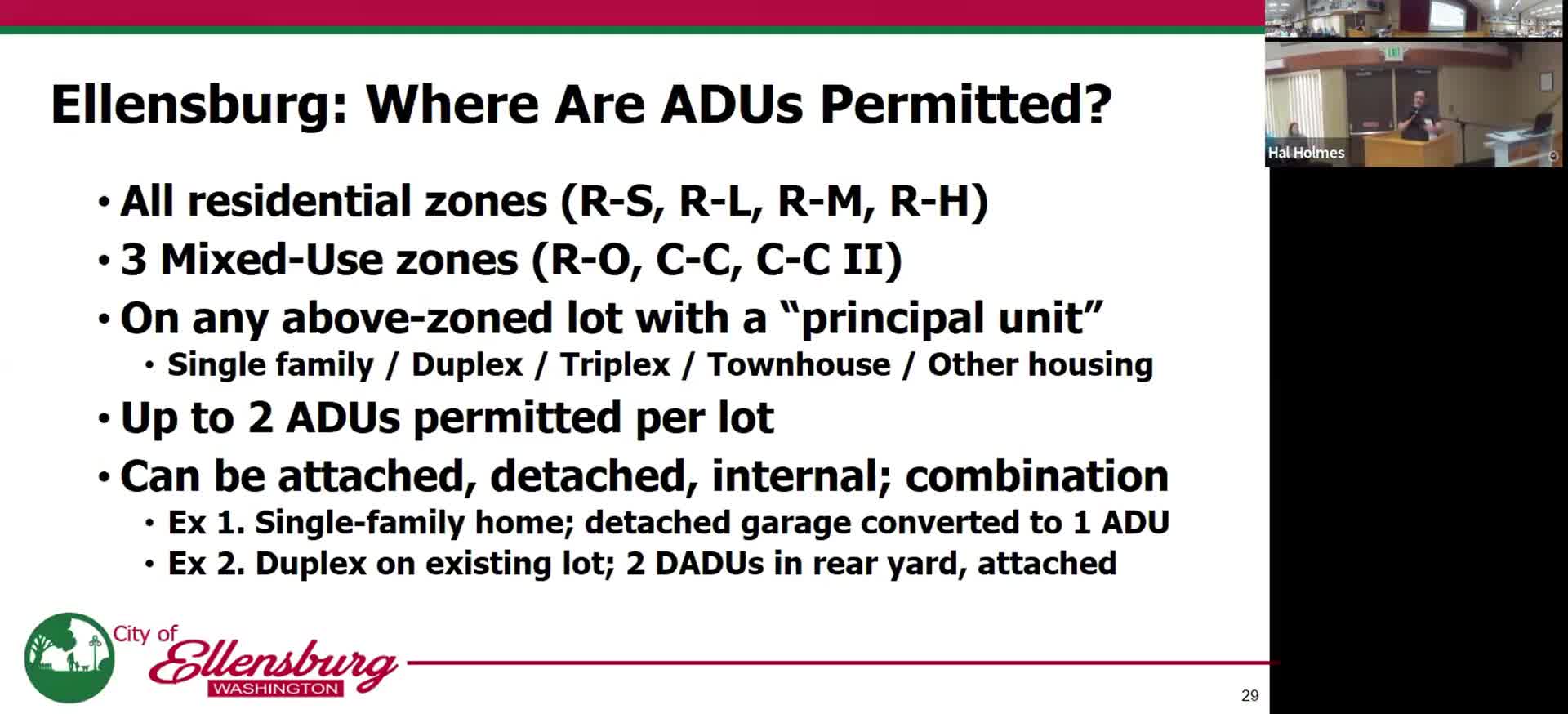
Summary
Mark Red of the City of Ellensburg detailed where and how accessory dwelling units (ADUs) are permitted in city residential and mixed-use zones, including a 1,000 sq. ft. interior cap, up to two ADUs per eligible lot, and minimum separation and setback standards.
At a city meeting, Mark Red, associate planner with the City of Ellensburg Community Development Department, outlined the city’s current rules for accessory dwelling units, saying, “We permit, for the development of accessory dwelling units in all of our residential buildings.” The rules allow up to two ADUs on eligible lots and set a maximum interior habitable area of 1,000 square feet.
The city permits ADUs in the RS (suburban residential), RL (residential low), RM (residential medium) and RH (residential high) zones, and in three mixed-use zones that allow residential uses: RO (residential office), CC (central commercial) and CC2 (central commercial 2). A lot must contain a principal dwelling unit — including single-family homes, duplexes, triplexes, townhouses and similar housing types — to be eligible for ADUs.
Red said ADUs may be internal, attached or detached. Internal units can use existing attic or basement space if they meet code and permitting requirements; detached ADUs must be placed at the side or rear of the principal dwelling and, for new construction, cannot be in the front yard. The city’s code currently requires a minimum 15-foot separation between a detached ADU and the principal dwelling unless converting an existing structure that does not meet that standard; Red said the 15-foot separation is under consideration for amendment but has not been changed.
The code references the International Residential Code for the definition of interior habitable area. Red said the 1,000-square-foot limit counts interior habitable area and excludes hallways, bathrooms, closets, utility spaces and any areas with a ceiling height less than 7 feet. For detached ADUs, Red said minimum property-line setbacks apply: 5 feet from the rear property line and 5 or 10 feet from side property lines depending on zoning and lot size; units abutting an alley may be built up to the alley property line. Height limits for ADUs follow the same zone height limits that apply to the principal dwelling.
Red noted that ADUs on multifamily lots must meet the same multifamily design standards that govern principal buildings in those zones, including any open-space requirements that apply to the primary dwelling. He also said some site-specific dimensional and feasibility issues may affect whether two ADUs can be built on a particular lot and that staff would assess those on a project-by-project basis.
After the presentation, Red made himself available to answer zoning questions at an information table near the meeting entry and turned the meeting over to Jeremy Johnston of Quintetask County for the next agenda item.