
Local builders outline key steps, costs and timelines for ADU projects
Get AI-powered insights, summaries, and transcripts
Subscribe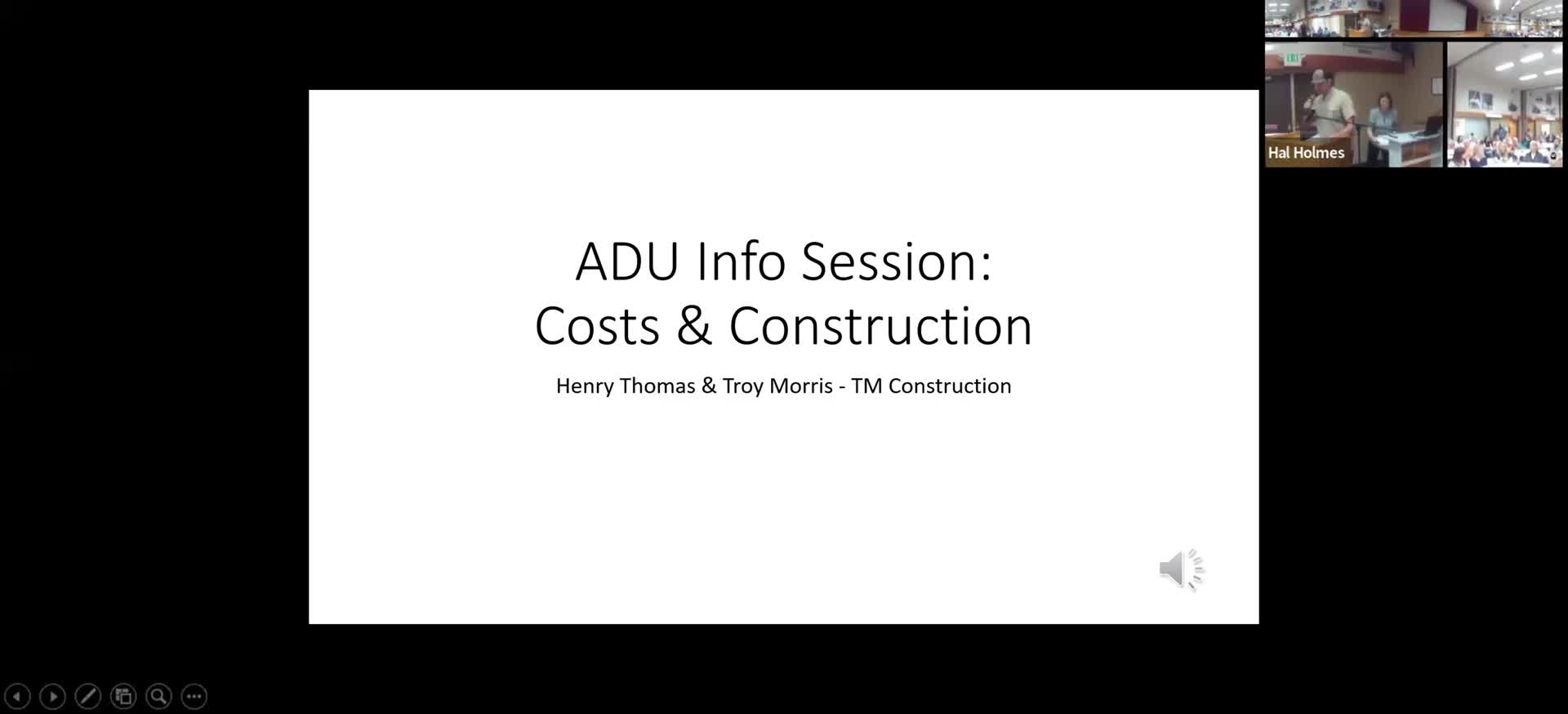
Summary
Builders from Tian Construction Group and TM told Kittitas County homeowners that clear goals, realistic budgets and attention to site utilities are the three most important factors for successful accessory dwelling unit projects; they gave example cost ranges and typical permitting and construction timelines.
Henry Thomas, a builder with Tian Construction Group in Kittitas County, and Troy, a presenter with TM, told residents that three planning steps — identifying needs, setting a budget and defining size and timeline — are critical before starting an accessory dwelling unit project. "What I wanna do today is walk you through the 3 most important things that we like to identify before you start any kind of ADU project," Thomas said.
The presenters said utility work and site preparation are often the largest sources of surprise costs. "If you have anything like a a sump pump or a ejector for your septic like Skyler touched on, that can add cost," Troy said, adding that utility connections and unknown underground conditions can push costs "upwards of $10,15, $20,000 even in the city." Both speakers emphasized that finishes and design complexity also drive price, and that compact or simpler shapes generally cost less than complex modern forms.
Thomas and Troy urged homeowners to clarify the primary use of the ADU — family housing, rental income or a lifestyle space — because that decision shapes layout and finish choices. "So the first step I always encourage homeowners to take is to write down exactly, you know, what the problem is we're looking to solve with this ADU," Thomas said. The presenters cited examples such as detached backyard units, garage conversions and attached units as different design responses to different needs.
On timelines, Troy said typical schedules in their experience run several months for permitting and longer for construction: "designing and permitting, at least in our experience, takes 4 to 6 months. Construction can usually take 6 to 12 months." He warned that crane scheduling, road closures and seasonality can extend that timeframe and that designers, builders and permitting staff often have full schedules.
Both speakers recommended engaging a builder early to avoid the common scenario where a homeowner pays for design work and later receives a construction estimate that exceeds the budget. Troy said builders can provide realistic cost expectations earlier in the process, preventing wasted time and expense.
They also cautioned that per–square-foot cost figures can be misleading: removing 10 square feet from a plan will not necessarily save a proportional amount because room-specific elements such as kitchens are far more expensive per square foot. "If you can take 10 square feet out of a building, you're not gonna save $2,000 or $3,000," Troy said.
The presentation concluded with an offer to continue conversations one-on-one: both presenters said they were available afterward at an information table and provided an office location for follow-up questions.
The discussion in this meeting segment was informational; no formal actions or votes were taken.