Get Full Government Meeting Transcripts, Videos, & Alerts Forever!
Get email alerts on the Teaching And Learning topic
No spam. Unsubscribe anytime.
Milton outlines teaching-and-learning priorities emphasizing data, classroom 'look‑fors' and regular walkthroughs
Summary
District leadership presented a plan to focus on Tier 1 instruction, increase use of data, raise classroom rigor, target underperforming students, and sustain positive climate. The instructional leadership team created classroom 'look‑fors' and will support weekly learning walks and SMARTE professional goals.
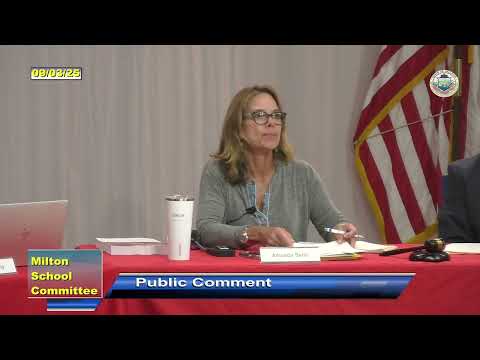
Milton school leaders presented a districtwide teaching and learning plan at the Sept. 3 School Committee meeting that emphasizes data‑driven instruction, clearly defined classroom “look‑fors,” and regular leadership walkthroughs to support teachers and target underperforming students.
Kala Khosa, the part‑time interim assistant superintendent for teaching and learning, told the committee the interim leadership team has set goals and systems to connect district priorities to classroom practice. “Because there’s an interim team in charge of the schools this year does not mean that learning has stopped or is paused,” Khosa said. “You only do third grade once. You only do eighth grade once. You only do senior year once, and we need to make this a very, very, effective and supportive and engaging school year for all students.”
The plan’s priorities, presented by Kyle Colson, are: provide all students with robust and intentional Tier 1 instruction; increase the use of data to inform instruction; increase rigor through high expectations and supports; take strategic action to ensure underperforming students achieve grade level; and continue to cultivate classroom and school climate to reduce absenteeism. Colson described a classroom “look‑for” tied to the priority of data use: real‑time instructional adjustments when teachers use quick assessments and immediately adapt instruction.
Implementation and monitoring: Colson said the full leadership team met Aug. 19 to analyze MCAS, DIBELS and i‑Ready data and translate priorities into observable “look‑fors” and SMARTE professional goals that align with those look‑fors. He told the committee district leaders will be visible in buildings and “in schools between once and twice a week,” walking with principals and convening regular curriculum leadership meetings to discuss themes from observations. Colson said the district will use those visits both as developmental learning walks and to model evaluation conversations; he described the evaluation schedule as requiring multiple formal observations per teacher across the year.
Committee discussion and next steps: Committee members praised the clarity and early timing of the work and asked for specifics on how frequently principals and central office staff would visit classrooms and how the district would ensure curriculum quality and task rigor. Colson said principals will prioritize observations of non‑tenured teachers early in the year and that, from an evaluation standpoint, teachers can expect multiple observations (he described roughly five formal observations over the course of the year as an example in the evaluation process) with additional learning‑walk visits occurring weekly across schools. Leadership said a series of in‑service days and follow‑up meetings will roll out the look‑fors to all faculty and that the district will bring specific updates to the committee on initiatives such as the K–5 ELA curriculum review.
Ending: District leaders said they will bring the K–5 ELA curriculum update to the committee in October and a procurement/selection update in February, and will return with periodic reports tied to the defined look‑fors and priorities.