
Deerfield SD 109 task force recommends two new elementary schools and two major renovations; plan would ask voters to help pay
Get AI-powered insights, summaries, and transcripts
Subscribe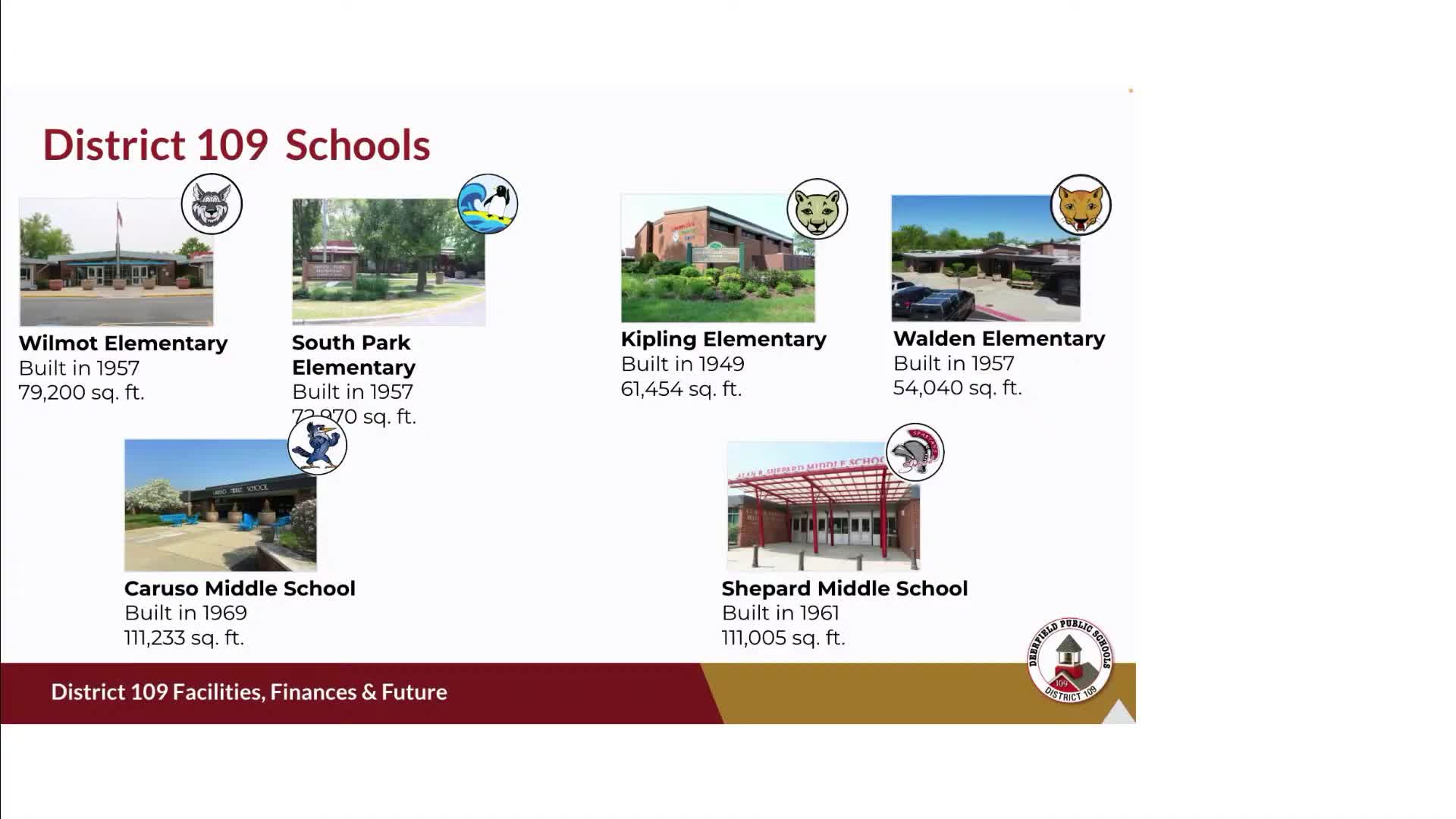
Summary
A citizen task force and district staff told the Deerfield SD 109 Board of Education that the district’s four elementary schools and two middle schools show widespread aging infrastructure and programmatic shortfalls, and recommended a ‘‘2+2’’ plan — two new elementary buildings and two major elementary renovations, plus targeted middle‑school upgrades — funded by a mix of reserve funds, alternate bonds and a voter referendum.
A citizen task force and district officials recommended that Deerfield SD 109 ask voters to approve a plan that would build two new elementary schools, renovate two existing elementary campuses and complete targeted renovations at both middle schools.
The recommendation — known in presentations as the 2+2 option — was presented to the Board of Education along with updated cost estimates, funding scenarios and a public engagement plan, and comes after a district facilities study that found aging mechanical systems, limited special‑education and support spaces, and circulation and accessibility challenges at multiple schools.
Why it matters: the district estimates the 2+2 plan would cost roughly $245 million (updated from earlier 2023 estimates), of which the task force modeled about 21% from district fund balance, roughly 30% from alternate bonds paid with operating funds, and 49% from referendum bonds. The district’s consultants said the proposal is intended to avoid higher emergency costs and prolonged disruption that could result from deferred maintenance.
The board heard presentations from the district’s owners‑representative and architecture/engineering consultants about building conditions. “The 4 elementaries were all, pretty much 75 years old and counting,” a facilities consultant said while reviewing square footage and circulation challenges at Walden, Wilmot, Kipling and South park. Consultants showed photos and described plumbing, HVAC and envelope work that, they said, has reached or exceeded typical life cycles.
District staff and the task force reviewed a broad range of options — from long‑term maintenance only to full replacement — and scored those against programmatic and infrastructure needs. Officials told the board that a “doing nothing” or maintenance‑only approach was estimated in 2023 at roughly $155 million over 20 years and, after recent construction‑cost escalation, would rise to an estimated $177 million. The task force concluded those approaches would not address fundamental educational or accessibility shortcomings at undersized campuses such as Walden.
The 2+2 recommendation calls for constructing new two‑story elementary schools at Walden and Wilmot, renovating Kipling and South Park with full access to plumbing and infrastructure during extended renovation windows, and targeted renovations at Caruso and Shepherd middle schools that focus on safety, special‑education space and building envelope/HVAC upgrades. Consultants described a sequencing plan intended to minimize disruption: build Walden and Wilmot first using existing sites so current buildings can remain in use during construction; open new schools for the 2028–29 school year; then perform the heavy renovations at Kipling and South Park to be completed by the end of the decade.
District officials said the 2+2 plan’s modeled funding would require referendum bond proceeds of about $121 million under a 25‑year bond model and estimated a tax impact of about $539 per $10,000 of equalized assessed value for the referendum portion. The presentations included an alternative 3+1 plan that the task force reviewed (three new elementary schools plus limited South Park work), which was estimated at about $277.2 million with a higher modeled tax impact.
The district emphasized it is in a comparatively strong fiscal position: the presenters noted recent recognition for budget reporting, a Moody’s upgrade in 2019 and that local property taxes provide the bulk of revenue. Staff said state Evidence Based Funding receipts (about $2.1 million in the prior fiscal year) and local property revenues support capital work without relying solely on referendum dollars.
Public‑engagement consultants Beyond Your Base outlined a five‑phase outreach program that will include a district landing page, informational videos, mailers, a tax‑impact calculator, and a mixed mail/text survey and thought‑exchange to gauge community support. The consultants proposed mailing a survey to roughly 8,200 households with a follow‑up text to about 10,430 registered voters and recommended a ballot date of March 17, 2026, if the board chooses to place a question before voters.
Board members asked for additional detail on emergency‑repair scenarios (how catastrophic failures could increase cost and disruption) and whether changes to early‑childhood programming should be considered; district staff offered to provide waiting‑list data for the preschool program to inform any further discussion.
Task‑force members and former board members who participated described strong consensus toward the 2+2 option after touring buildings. One task‑force member told the board: “I had no idea our facilities were this bad. I’m ashamed,” a remark staff said reflected the group’s reaction after walking Walden and other campuses.
Votes at a glance: several routine items on the meeting agenda passed by roll call during the same meeting. The board approved the consent agenda (personnel items, minutes and bills), accepted the treasurer’s report and approved a one‑year extension of the intergovernmental agreement with the local park district. Roll calls recorded those approvals (aye votes and absences are shown in the meeting record).
What’s next: the district said the board will consider the task‑force recommendation and review public‑engagement results. Staff outlined a timeline in which middle‑school summer work could begin June 2026, new‑school construction for Walden and Wilmot could begin in mid‑2027, and the district would open new elementary buildings for the 2028–29 school year if a referendum proceeds and funding follows the modeled schedule.
The board did not take a final vote to place a bond question on the ballot during this meeting. Staff and consultants said they will return with additional data, community‑survey results and a more detailed tax‑impact calculator before the board decides whether to move forward.