Council weighs two public-works facility options: renovate/infill (~$5M) or full rebuild (~$8M); no binding vote
Summary
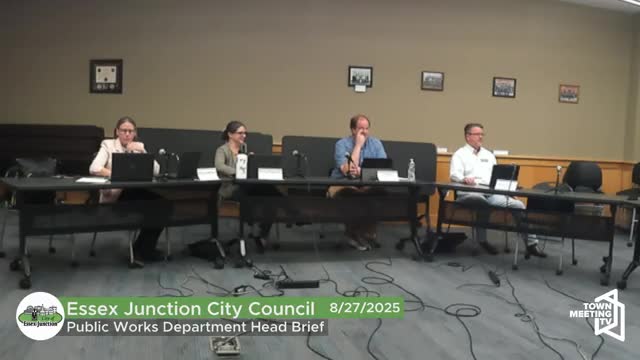
Essex Junction — City staff presented two concepts for a new Public Works facility on Aug. 27: a roughly $5 million infill/renovation that preserves operations during construction, and an approximately $8 million full rebuild that would replace most site buildings but require temporary relocation of operations.
Essex Junction — City staff and a project presenter laid out two early concepts on Aug. 27 for replacing or upgrading the Public Works facility on Jackson Street: a renovation/infill option estimated at roughly $5 million and a full rebuild option in the neighborhood of $8 million.
The presentation, led by a project presenter (identified in the record as Rick) and Public Works Superintendent Ricky Jones, showed site diagrams, existing building footprints and two conceptual plans. The “Version 1” infill option would connect an existing 2,000-square-foot water building to a 5,388-square-foot barn via a new 9,900-square-foot addition; the plan preserves much of the current site so operations could continue during construction. The presenter said Version 1’s preliminary cost estimate is “in the ballpark, $5,000,000.”
The “Version 2” option would demolish most site structures (keeping only the corner salt shed) and build a single new facility of about 21,000 square feet. The presenter gave a preliminary estimate for that option in the “ballpark” of $8,000,000. Both concepts included improvements to granular-material storage: an additional covered salt bay and roofed bins for gravel, cold patch and topsoil.
The council’s discussion focused on trade-offs: Version 1 preserves an on-site working facility during construction and reduces relocation needs for equipment and staff; Version 2 creates a single, modern facility with potentially lower long-term maintenance needs but would require moving staff and much of the rolling stock off-site for the construction period. The presenter said Version 1 was informed by other communities’ experiences (including a New Hampshire case that took far longer than expected when a community demolished everything and rebuilt) and that a staged infill can reduce disruption to operations.
Councilors asked about square footage, equipment layout, storage for salt and granular materials, timeline and procurement approach. The presenter displayed an inventory of rolling stock and explained both options accommodate the town’s existing vehicles and equipment; ceiling height constraints in the existing barn mean some large pieces cannot fit under the current roof. He estimated a realistic construction schedule at roughly a year from ground-breaking to occupancy for either approach, and said demolition could add time depending on hazardous-material abatement.
Councilors referenced nearby municipalities that recently built public-works facilities (Saint Albans, Georgia, Milton) and discussed design-build procurement and possible donor or bonding strategies. Several councilors emphasized the importance of framing the need for voters: public outreach and an open house would help the public understand why the project is needed and what they would get for the cost.
No formal vote was taken; councilors expressed preferences. Multiple councilors said they favored the option that would allow operations to continue on-site during construction (the infill/Version 1), citing continuity; other councilors said a full rebuild would provide a more durable long-term solution. At the end of the discussion one councilor stated a preference for Version 2 and another said they preferred Version 1; staff reported they will continue developing cost and financing information and will “work backwards from a bond vote” should the council choose to seek voter authorization.
Why it matters: The facility project would be a multi-million-dollar capital investment that affects maintenance capacity for roads, water, wastewater and other municipal services and could require a bond vote. The choice will affect where equipment is stored, how quickly crews can respond in winter storms, and the civic communications needed to obtain voter support.
Next steps: Staff will refine cost estimates, review debt capacity and budget impacts, consider procurement approaches (including design-build), and develop public outreach including an open house so residents can see facility needs and proposed benefits. Council did not take a binding vote at the Aug. 27 meeting.