
Public works briefs council on staffing, winter readiness and a sewer-camera test that 'burped' into homes
Get AI-powered insights, summaries, and transcripts
Subscribe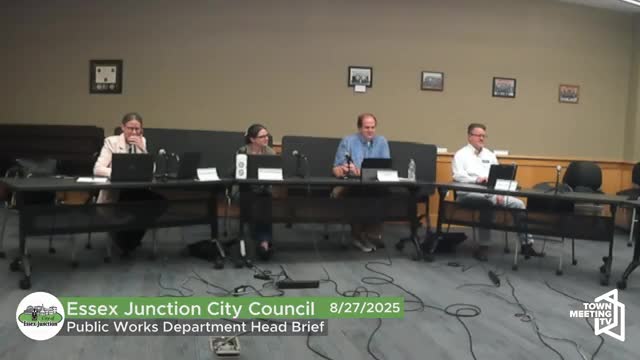
Summary
Public Works Superintendent Ricky Jones reported the department is fully staffed, completed key projects, and is testing a new sewer camera mounted on a ‘Super Sucker 7,000’ that caused temporary sewer "burping" into some homes on Grove Street; staff said they will adjust procedures and share video with council.
Essex Junction — Public Works Superintendent Ricky Jones told the City Council on Aug. 27 the department is fully staffed for the first time in a long time, completed seasonal work including pavement, and is supporting wastewater staff with a new camera system mounted on the department’s Super Sucker 7,000 vacuum truck.
Jones said the department assessed contracting costs for snow and road-painting work and kept services in-house; crews finished pavement and marker work in time for the first day of school and have been assisting with building maintenance at Lincoln Hall and the library. He said staff have been troubleshooting traffic-signal cameras in the Five Corners area and are budgeting for updated camera technology.
On sewer work, Jones described tests with a new camera package installed on the Super Sucker 7,000. He said operators added a “skid” to raise the camera head so it records above the water line, which made the head heavier and required higher jetting pressure. That combination has, in a few cases, pushed sewer water into fixtures at some residences — Jones described this as “burping” toilets when pressurized flows expelled trap water in toilets and briefly sent sewer odors into homes.
Jones said operators spoke directly with one to three affected residents and downloaded video for review. He told the council the department will stop using the skid on 8-inch pipes and, where possible, reduce pressure or operate between manholes to avoid pressurization that can force water into homes. He characterized the event as a side effect of the new equipment’s greater cleaning power, not as dirty-water discharge, and said traps typically refill on the next flush.
Councilors asked whether the city can notify neighbors in advance when flushing or TV-ing is planned. Jones said the city runs full-network flushing on multi-year cycles (roughly every four or five years) and performs annual cleaning on problem lines; he said citywide flushing notices already occur in spring and fall but that targeted notifications for specific streets are difficult because schedules change day-to-day. Councilors asked staff to explore communications options to warn nearby residents when crews will be performing work that might temporarily affect household fixtures.
Jones and the council also urged residents not to put grease or so-called “flushable” wipes into sewer lines. Jones said the department is testing camera footage and will provide video to staff for review and follow-up with affected residents.
Why it matters: Department readiness, equipment use and sewer maintenance affect routine operations, water quality perception, and homeowner experience. The city’s response — procedural adjustments, targeted outreach and review of camera operation — will shape whether similar incidents recur.
Next steps: Staff will review the camera footage, modify operational procedures for the new camera head, avoid using the skid on certain pipes and explore targeted communication methods for flushing/TV work. Council asked staff to report back on any further actions.