Get Full Government Meeting Transcripts, Videos, & Alerts Forever!
Get email alerts on the Public Facilities District topic
No spam. Unsubscribe anytime.
Ellensburg council backs further talks on countywide public facilities district to fund recreation
Summary
City council voted to continue partnership discussions on forming a countywide public facilities district to raise voter-approved sales tax revenue for large recreation projects including a pool and a field house, following presentations from city staff and Upper County recreation advocates.
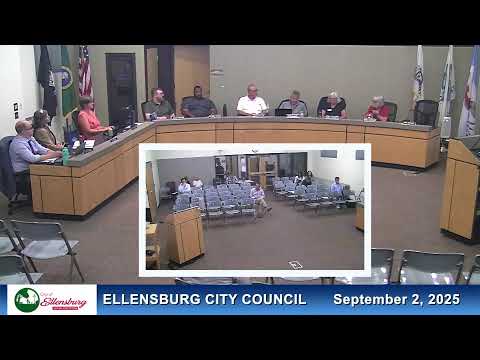
The Ellensburg City Council on Sept. 2 voted to continue partnership discussions about creating a countywide public facilities district to raise voter-approved revenues for large recreational facilities serving both lower and upper Kittitas County. City Manager Heidi Brown and representatives of the Upper Kittitas County Recreation Center Alliance urged exploring a PFD as a way to spread costs and create a sustainable funding stream for projects such as a replacement field house and a new pool.
Brown said the model is permitted under state law and emphasized the city’s budget constraints and competing service priorities. She told the council the countywide 0.2% sales-tax option could, at current levels, generate an estimated $4,000,000 per year and provide roughly $52,000,000 in bond capacity for capital projects when modeled across typical debt-service terms. She said the PFD would be a municipal corporation with a five-member board and that any sales-tax proposal would require voter approval and a Department of Commerce feasibility review.
The council heard from Paul Campbell, a leader of the Upper Kittitas County Recreation Center Alliance, who said the alliance “endorses [this] in the strongest possible terms” and described the alliance’s multi‑year work to develop a 53,000-square-foot recreation center in Cle Elum. Gary (last name Burt), participating by phone, said the alliance has secured more than $2 million in public support to date and is pursuing additional local commitments while the PFD would be intended primarily to address operating shortfalls.
Council members and staff discussed formation steps, governance, and sequencing. Brown and alliance leaders described a two-track approach: a PFD to generate ongoing operating revenue (typically a voter-approved sales tax) and then, if necessary, a separate parks district or bond vote to finance construction. Alliance leaders said their model assumes the PFD would cover a majority of operating shortfalls while a metropolitan parks district and bond levy would fund construction costs.
Councilmember motioned to continue formal partnership discussions and staff work to prepare a proposal for the Board of County Commissioners; the motion was seconded and passed. The council did not commit to any specific tax amount, apportionment method, or timeline; those details will be part of further interlocal discussions and the Commerce feasibility process.
Why it matters: the PFD approach would spread the cost of large, long-lived recreation facilities across county consumers and visitors rather than concentrating the cost solely on city property taxpayers. The idea aims both to help replace facilities that the city has identified as priorities and to support planned recreation projects in Upper County communities.
Next steps: staff and alliance representatives said they will continue interjurisdictional discussions, assemble required feasibility materials for the Department of Commerce review, and coordinate an outreach package for the county commissioners and the public. No voter measure or tax was placed on the calendar by the council at the Sept. 2 meeting.