
Developer presents 33‑unit affordable housing concept for city‑owned Main Street site; council gives preliminary support
Get AI-powered insights, summaries, and transcripts
Sign Up Free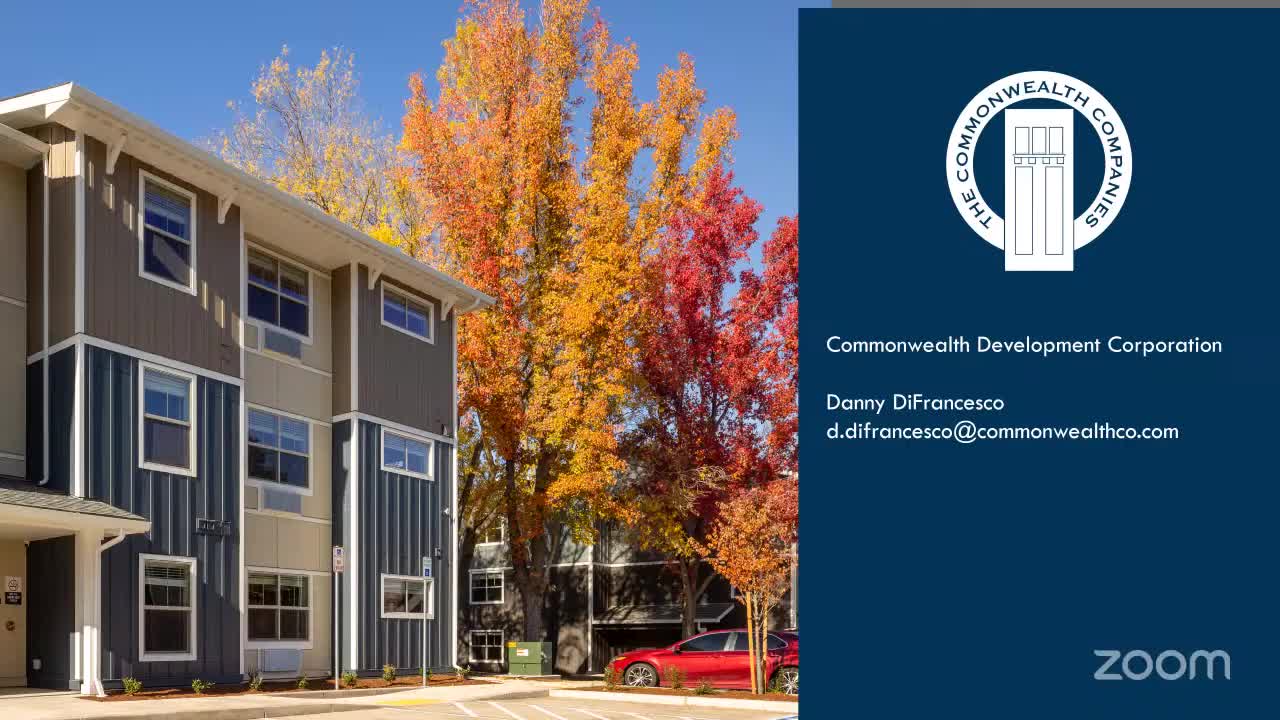
Summary
Commonwealth Development presented a concept for a 33‑unit, four‑story affordable housing building on a city‑owned half‑acre site at 1917 Main Street and the Philomath City Council gave preliminary support to proceed with partnership negotiations.
Commonwealth Development presented a conceptual plan for a 33‑unit affordable housing building on a city‑owned half‑acre site at 1917 Main Street (corner of North 20th and Pullamette) during the Philomath City Council meeting on Aug. 11. The developer described a four‑story mid‑rise with roughly 26 one‑bedroom and seven two‑bedroom units, onsite property management, community room and surface parking, and said all units would be restricted at or below 60% of area median income (AMI) under the proposal.
“...we are long term owner[s],” said Danny DiFrancesco of Commonwealth Development, describing the company—s approach to building and operating affordable properties and noting Commonwealth—s work in Oregon since 2018, including recent projects in Corvallis and Newport. He said the project concept is intended to match Philomath—s scale and character while meeting state affordability and energy efficiency guidelines.
DiFrancesco walked the council through an indicative capital stack: federal low‑income housing tax credits, state gap financing (referred to as Lift/local innovation funds), a first mortgage, and deferred developer fee. In Commonwealth—s current illustration the developer assumed a nominal land contribution from the city (shown in the concept as $1) and noted that local supports such as fee waivers or reduced SDCs materially improve feasibility. The developer also said the project team would pursue funding from Oregon Housing and Community Services (OHCS) and other sources; a successful OHCS award would lead to a plan‑review submittal and a roughly 14‑month construction schedule.
Councilors raised design, operations and affordability questions: parking location (councilors preferred parking at the rear for quieter units), whether on‑site management would include a unit (developer replied no manager unit), building‑height and fire‑safety implications (councilors asked staff to involve the fire marshal early), and the mix of income tiers (30/50/60% AMI) within the 33 units. Councilor Nielsen asked how many units would be reserved at deeper affordability (30% and 50% AMI versus 60% AMI); the developer said the presented mix was indicative and depends on the project—s eventual capital stack and the amount of gap financing secured.
Councilors and staff signaled support for moving into detailed negotiations and site control steps. Council consensus directed staff to proceed with the partnership and to schedule follow‑up discussions: “We will have staff move forward with the partnership with Commonwealth, and get back to us if needed next steps in the next month or so,” the mayor said. The developer noted a timeline that assumes an OHCS award or reservation in September–October 2025, five months for design and financing steps after award, and a 14‑month construction schedule that could allow occupancy in 2027 if funds and approvals align.
The council and Commonwealth also discussed options that could increase deeper affordability, including additional grant sources, local fee adjustments, and the potential benefits of economies of scale for larger projects. Several councilors observed that while a portion of units at 60% AMI will produce higher rents than the lowest‑income thresholds, any additional subsidized units would represent an improvement over the current vacant parcel. Staff and the developer agreed to hold further meetings, and the council did not take a binding vote; rather, members gave preliminary, informal support to proceed with negotiations and next steps.