
Philomath reviews utility rate options as consultant warns of large water and stormwater shortfalls
Get AI-powered insights, summaries, and transcripts
Subscribe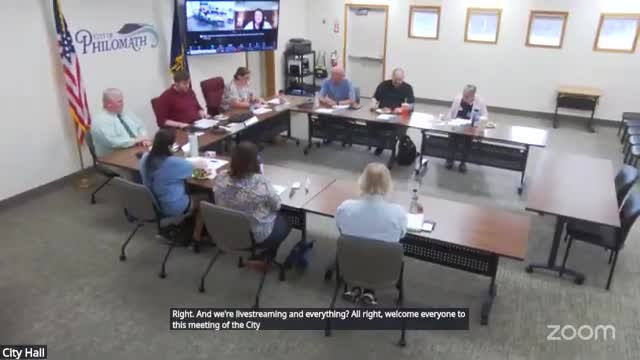
Summary
A Raftelis consultant laid out options to raise water, sewer and stormwater revenues at a Philomath City Council work session Sept. 8, citing a shortfall for a planned water treatment plant and an under‑recovering storm drainage utility. Councilors asked for more scenarios and a phased approach; no formal action was taken.
PHILOMATH, Ore. — At a Sept. 8 work session, the Philomath City Council heard a consultant lay out proposed changes to how the city collects water, sewer and storm drainage revenue and asked staff to return with more scenarios before deciding.
Jen (vice president, Raftelis Financial Consultants) presented a draft rate design and a five‑year financial model and said the city faces a need to raise revenue to cover upcoming capital needs — most notably a new water treatment plant — and to correct under‑recovery in the storm drainage utility. “So I’m back today hoping that we can talk through some of the remaining items and get guidance on how to proceed,” she said.
The nut of the discussion was how to redesign rates so the city recovers the revenue it needs while limiting bill shock. Raftelis presented options including: raising the share of water revenue recovered through fixed (meter) charges from about 25% to roughly 30%; moving multifamily fixed charges to a per‑meter basis; adopting tiered volumetric water charges (two or three tiers) instead of a single uniform volumetric charge; adding an elevation surcharge for customers served by pumps; modifying private fire service standby fees; and reworking the storm drainage tariff so charges scale more consistently with impervious surface area.
Raftelis provided specific figures to frame the choices. The firm estimated an overall water revenue increase in the model of about 24% and an FY27 water revenue target built from operations, capital and some borrowing; the FY27 incremental revenue need for water was presented as roughly $2,400,000. Under a uniform volumetric approach the consultant showed an illustrative unit rate rising from about $6.55 per CCF to about $7.71 per CCF (an unrounded, draft figure the presenter said would be rounded before any final ordinance). Jen recommended increasing the share of water revenue from fixed charges to improve revenue stability: “I recommend that, we sort of bump up that 25% to about 30%.”
Storm drainage was a focal point: Raftelis said Philomath is under‑recovering stormwater costs and that the current structure — 17 tiers based on impervious area — charges small commercial properties far more per square foot than the largest properties. The consultant recommended compressing and rebalancing tiers so that charges scale more consistently with impervious area, which would raise larger customers’ bills and reduce the burden on single‑family accounts. Without structural change, Raftelis showed a scenario in which stormwater rates could require very large across‑the‑board increases; by adjusting the tariff structure the average single‑family increase presented in the slides would be lower than the alternative. Raftelis also illustrated a typical single‑family stormwater charge in the proposal near $10 per month.
A pair of technical surcharges drew pushback. The firm proposed a volumetric elevation surcharge to recover the incremental cost of pumping water to higher‑elevation customers; the consultant calculated that surcharge at about $0.74 per unit and said elevated customers represented roughly 7.5% of residential usage in the test year. Raftelis also recommended reallocating private fire service charges so both private hydrants and private fire lines share the standby cost rather than billing only private fire lines. The slides showed the current private standby fee at $15.20 and inventory counts of about 37 private hydrants and 27 private fire lines; some councilors and a resident raised concerns about the scale of increases to those customers.
Councilors asked for clarifications and more granular scenarios. Councilor Diane Crocker and others said increases for private fire services and elevation surcharges could be large and urged phased implementation. A resident who identified herself as Simone said: “The private fire lines and hydrants, it’s a huge change for most of them, and I am concerned about that.” Several councilors asked staff to return with (1) an analysis showing the bill impacts for light, medium and heavy residential users under the different tier structures, (2) phased implementation options (longer than a three‑year phase‑in if desired), (3) a clearer inventory and distribution of private fire services by fee tier, and (4) alternative scenarios that push some capital projects out to show the sensitivity of rate needs to project timing.
On sewer, Raftelis recommended maintaining the current revenue target (sewer revenue needs were not driving an immediate increase in the model) but offered an optional loading charge to account for high‑strength dischargers (restaurants, laundromats, distilleries). That option had less visible support in the discussion and attendees asked for more consideration before pursuing it.
Councilors also discussed the water treatment plant funding picture. Jen said the city previously obtained a state legislature grant of about $12,000,000, but that inflation and higher construction costs mean the grant will not cover total construction costs and the city will need additional funding sources such as borrowing or higher rates.
No motions or votes were taken at the work session. Councilors directed staff and the consultant to prepare follow‑up materials, including multi‑year scenarios, phased‑in implementation schedules, bill‑impact examples for representative households, and more detailed breakdowns of private fire service counts and hydrology tiers. The council recessed the work session at 7:06 p.m. and planned to continue rate deliberations at a future meeting.