Get Full Government Meeting Transcripts, Videos, & Alerts Forever!
Get email alerts on the Land Use Solar topic
No spam. Unsubscribe anytime.
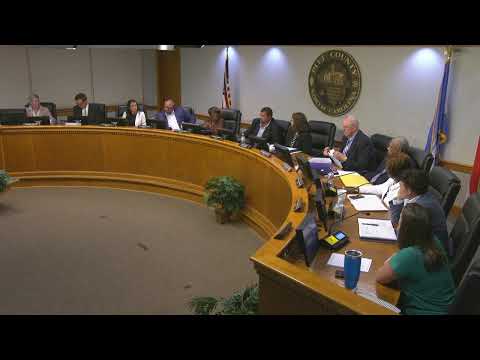
Pitt County approves conditional rezoning for 1,048-acre Stokes Town Solar project after lengthy public hearing
Summary
The Board of Commissioners approved Hexagon Development LLC's conditional rezoning to permit a large-scale solar facility east of Grifton after a public hearing with 29 speakers for and against the project. Developers agreed to expanded setbacks, decommissioning guarantees and a $100,000 voluntary park donation to the town of Grifton.
The Pitt County Board of Commissioners on Aug. 18 voted to approve a conditional rezoning requested by Hexagon Development LLC to allow a large-scale solar energy facility — the Stokes Town Solar project — on about 1,048.94 acres east of Grifton.
Planning staff told the board the county’s Envision Pitt County 2045 future land-use map designates the area as agricultural and staff found the conditional rezoning consistent with the plan; the planning board had recommended approval by a 6-1 vote at its July 16 meeting. Commissioners then heard more than two hours of public comment, with 29 people signed up to speak.
The project assembled roughly 1,500 acres under option, the developer said, but the area inside the proposed fenced project boundary will be about 416 acres and the panel footprint about 115 acres. Hexagon representatives said the project would include an 80-megawatt generation system paired with a 30-megawatt battery storage system, use underground wiring where required, and include a decommissioning plan required under recent state law.
Why it matters: supporters said the project brings long-term lease revenue for landowners, property-tax revenue for the county, and local jobs during construction and operation; opponents raised concerns about property values, flood risk, wildlife and long-term health effects. Commissioners approved the rezoning with conditions described by planning staff and with additional, developer-agreed commitments about larger setbacks in sensitive areas.
Major facts and conditions - Applicant: Hexagon Development LLC; project described as the Stokes Town Solar project. - Size and footprint: rezoning requested for 1,048.94 acres across 15 parcels/8 owners; fenced project area ~416 acres; panel area ~115 acres (figures provided by applicant). - Setbacks and buffers: Hexagon told the board it self-imposed a 300-foot minimum setback from nonparticipating residences across the project and committed to 500-foot setbacks along specific roads (Hexagon requested those distances be memorialized in the conditions). The county ordinance requires a 50-foot setback from property lines and 100-foot separation from residences for solar facilities; the applicant exceeded those minima in many locations. - Development standards required by county staff and included as conditions: site plan and zoning compliance permit before construction; erosion and sedimentation controls; a 50-foot riparian buffer along streams on site; compliance with Pitt County stormwater rules; required permits from the Pitt County Inspections Department and NCDOT driveway permits; fencing, screening and emergency signage; removal of abandoned equipment after one year of inactivity. - Permits and review: applicant must obtain required environmental permits and NPDES (National Pollutant Discharge Elimination System) approvals from the North Carolina Department of Environmental Quality (NCDEQ) before construction. FEMA floodplain limits must be respected; applicant said the design avoids FEMA floodplain areas and wetlands where feasible and that NCDEQ review of stormwater and floodplain issues will be required. - Decommissioning: Hexagon referenced the June 2023 state law (North Carolina House Bill 130) requiring decommissioning financial assurances for projects >2 MW and said a bond or similar security will be placed and renewed periodically to cover removal costs. The developer said the decommissioning estimate and bonding amount are included in its application and will be reviewed and updated periodically.
Public comment and technical presentations - Supporters: several landowners and representatives said leases provide steady income and a way to preserve family farms for future generations. The developer offered to donate $100,000 to the town of Grifton for a public park; the town board had unanimously approved that agreement. Local and regional speakers in favor included landowners (for example, Glenda Cannon and Gary and Wendy Evans) and economic-development voices who said the project would generate tax revenue and local jobs. - Opponents: residents including Robert Rouse, Justin Rouse, Teresa Lupton and others voiced concerns about property values, long-term environmental and health impacts, and flood risk. Multiple speakers asked for more independent soil and water testing and questioned whether battery storage posed emergency-response risks. - Technical experts for the applicant presented studies and findings: an economic analysis estimating multi-million-dollar tax revenue over the project life and millions in construction output; a hydrology and hydraulic study (Tetra Tech) modeling ponding during a 100-year storm and informing layout changes to avoid lowest-elevation ponding areas; an acoustical study predicting predicted noise levels that comply with Pitt County limits (county limits cited as 55 dBA daytime and 50 dBA nighttime for residential receiving properties); and an appraisal study stating that the applicant's review of matched-pair studies did not show substantial injury to adjoining property values.
Discussion versus action - Discussion: Commissioners and many speakers debated site design, setbacks, decommissioning guarantees, stormwater and flood risks, battery storage safety, and the economic trade-offs of preserving farmland via long-term solar leases. Several commissioners asked for the developer’s voluntary commitments to be memorialized as conditions. The county manager and planning staff clarified regulatory steps required before construction. - Formal action: After public comment and deliberation, a motion was made and seconded to adopt the planning board’s consistency statement and approve the conditional rezoning with the conditions described in staff materials and the additional setback commitments the developer agreed to. The board voted to approve the rezoning (motion outcome: approved; roll-call tallies were not recorded in the public transcript).
Next steps and dependencies - The rezoning approval is a land-use action; the project still requires a zoning compliance permit, detailed site plan approval, NCDOT commercial driveway permits, NCDEQ permits (including NPDES where applicable), and utility interconnection agreements (the developer said Duke Energy would be the offtaker/operator). Decommissioning bonds and updated cost estimates must be filed before construction.
Speakers quoted in this report are limited to individuals who addressed the commission during the public hearing and staff presentation. Developer statements are attributed to Allie (Ali) Kranz, director of development for Hexagon Energy; technical findings were presented by Mina Recta (Tetra Tech), Bill Yoder (Ascentec acoustics), Ty Sutton Jr. (Sutton Shively Real Estate Appraisers), and Ross Svetz (Hexagon project developer).