Get Full Government Meeting Transcripts, Videos, & Alerts Forever!
Get email alerts on the Solid Waste Management topic
No spam. Unsubscribe anytime.
Solid Waste Board approves 2024 annual report; new department to stand up July 1
Summary
The Metro Solid Waste Board approved the 2024 Annual Progress Report and solid waste management plan after a presentation on recycling, composting pilots and a planned standalone solid waste department that will take effect July 1.
The Solid Waste Board voted to approve the 2024 Annual Progress Report and solid waste management plan at its meeting, with the board recording unanimous support from members present.
The approved report summarizes Metro’s recycling and landfill data, an organics pilot that has collected roughly 308,000 pounds of food scraps since it began in October 2023, and a reorganization that will make the city’s solid waste functions an independent department on July 1, 2025.
The report presentation reviewed curbside recycling and drop‑off services, convenience centers, composting and the results of public‑private recycling contracts. Tracy Thurman, the newly hired director for the stand‑alone solid waste department, told the board that creating a separate department will “bring in the expertise… [and] the people really needed to drive these programs forward,” and will allow the city to expand staff and back‑office functions such as finance, HR and IT that support operations.
Board staff said the food‑scraps pickup pilot serves about 750 households and has averaged “a little over 6 pounds, close to 7 pounds per household per week,” yielding about 308,000 pounds of organics since the pilot began on Oct. 23, 2023. The presentation also noted 120 employees currently support the waste services division, not including staff in other departments that contribute to solid waste work.
Presenters described obstacles to increasing diversion: limited local infrastructure and markets for recyclables, state restrictions on local packaging rules (referred to in the report as a “ban on bans”), inconsistent labeling of plastics that drives contamination, and constrained local funding because solid waste programs operate from the general fund rather than a dedicated enterprise fund. Board members and staff discussed options such as an enterprise/refuse fee, regional material recovery facilities (MRFs), and expanded organics processing as ways to reduce landfill tonnage and exposure to changing landfill access.
Board members also raised capacity concerns at Middle Point landfill and recent proposals in Rutherford County to limit out‑of‑county volumes. Staff said Metro’s disposal contract runs through 2027 and protects Metro collection until that contract expires; after 2027 disposal service would be procured through a competitive bid. Tracy Thurman said the department is evaluating bid specifications and looking for diversion opportunities, including construction and demolition (C&D) material policies, additional recycling processors and organics infrastructure.
The report lists existing revenue sources and described a county surcharge of $6 per ton on MSW waste generated in Davidson County that goes to transfer stations or landfills, plus $1 per cubic yard returned from C&D disposal. Staff also told the board they realized about $4 million in savings after Metro assumed certain curbside collection routes previously contracted to a vendor.
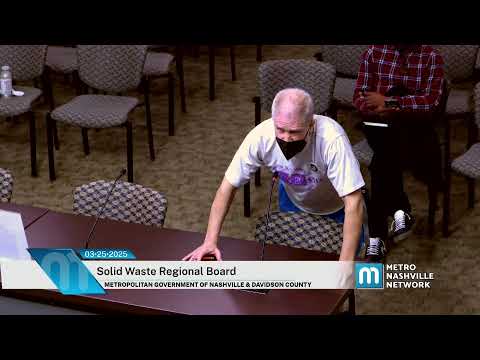
During public comment, resident John VanderHurst criticized the pace of recycling and processing development and said the private waste industry “is… very, very profitable. They are rolling in money, but what they do is they spend money on the politicians.” The board did not take action tied to that comment; it proceeded to the vote to approve the report.
A motion to approve the 2024 Annual Progress Report and solid waste management plan was made and seconded; the board voted aye and recorded no abstentions. The meeting then adjourned.
The approved report will remain part of the record that Metro submits to the Tennessee Department of Environment and Conservation, which requires annual progress reports under the state Solid Waste Management Act of 1991.