
Arcata council adopts CEQA exemption and amends Trillium Creek planned-development permit to remove affordable-housing requirement
Get AI-powered insights, summaries, and transcripts
Subscribe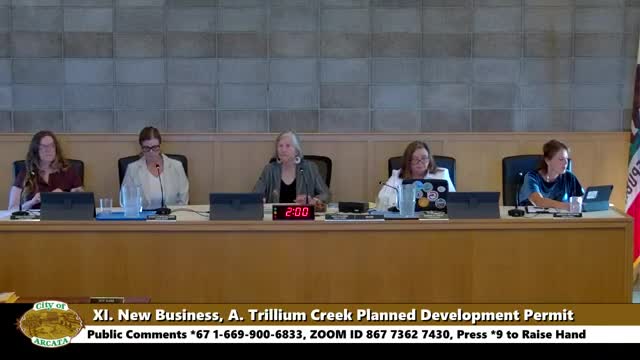
Summary
The council approved a CEQA exemption and amendments to the Trillium Creek planned development permit that remove prior affordable-housing restrictions on two lots; staff said the subdivision has been long delayed and contains eight lots and significant wetland remainder.
The Arcata City Council on Aug. 20 voted to adopt a CEQA exemption and approve amendments to the Trillium Creek planned development permit that remove a prior affordable-housing requirement for two small lots in the subdivision.
Joe Mateer, senior planner in the Community Development Department, told the council the project spans about 24 acres, with roughly 17 acres preserved as a remainder containing Trillium Creek and onsite wetlands. The subdivision is proposed to create eight lots; two are small parcels that staff said would have lower land costs and that providing affordable units on those lots would be unusually costly relative to the size and timing of the project.
Mateer told the council staff reviewed the mitigated negative declaration and found the changes were not associated with any additional environmental impacts related to the affordable-housing conditions. He noted that past city councils had removed similar regulatory-agreement requirements for other small subdivisions and reminded the council that the city’s inclusionary-rental policy applies to projects of 60 or more units, whereas Trillium Creek proposes eight units.
A member of the public, Joanne McGarry, spoke in favor of allowing the project to move forward after long delays; she urged the council to approve the amendments so creative housing can proceed.
After public comment, the council voted to adopt the CEQA exemption (per Cal. Pub. Res. Code § 21000 et seq. guidelines referenced generically in the staff report) and to amend the planned development permit conditions as recommended by staff. The motion passed with all council members recorded as saying “aye,” and no “nay” votes noted in the transcript.
The council’s action removes the specific condition requiring two lots to be restricted to low- and moderate-income households; staff did not record any new affordable-housing replacement requirement during the meeting. City staff said the subdivision has a long history of delays and that the change recognizes the project’s smaller scale relative to the city’s inclusionary standards.
Implementation steps, such as recording amended permits and any associated public-access easements, will be handled by the Community Development Department and are subject to standard conditions and any recorded mitigation measures noted in the adopted environmental determination.