Get Full Government Meeting Transcripts, Videos, & Alerts Forever!
Get email alerts on the Transportation Parking topic
No spam. Unsubscribe anytime.
Council signals consensus to revert Cota Street temporary traffic-calming after year of complaints
Summary
Public works presented a yearlong evaluation of the temporary Cota Street traffic‑calming measures; staff outlined costs and options and council members signaled consensus to pursue reverting to the prior parking configuration while staff develops a refined plan and public outreach.
The Shelton City Council study session on Aug. 26, 2025 heard an update from Public Works Director Jay Harris on the temporary traffic‑calming changes on Cota Street and signaled consensus to pursue Option A—reverting to the pre‑project parallel‑parking configuration—while staff develops a refined plan and public outreach strategy. No formal council vote was taken at the study session.
The change on Cota Street began with a downtown vision and Creative District planning process that included “green street” concepts; the city installed a temporary configuration in 2024 that uses reverse curves (sometimes called chicanes) and 60‑degree diagonal stalls in place of the earlier parallel parking. Harris described the project history and data, and presented two options: (A) revert to the previous striping and restart traffic‑calming planning, or (B) improve the temporary striping and proceed to a permanent corridor design with stormwater planters and other green‑street features.
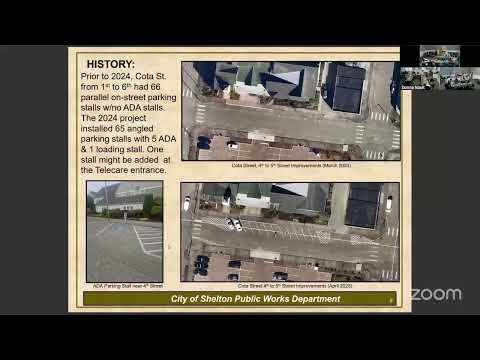
Harris said the corridor now has about 1,500 vehicle trips per weekday and that the 85th‑percentile speed is about 20 miles per hour: “we're getting about 1,500 trips per day,” and “85% of the traffic is traveling at 20 miles an hour or less,” he told the council. He traced the striping changes: before 2024 there were about 66 parallel on‑street stalls with no ADA stalls; the temporary layout measures roughly 65 parking stalls, five ADA stalls and one loading stall near TeleCare. He warned that reverting the striping will require hydroblasting concrete, re‑scribing centerline and parking stalls and complying with the city’s public right‑of‑way accessibility standards; he estimated roughly $25,000 to revert, of which about $9,000 is staff time.
Council members and other speakers described mixed reactions from residents and businesses. One attendee identified in the transcript as Lindsey said, “It is my personal opinion that I do not think this design works for our city… I will be voting for option a.” Other speakers said the temporary changes have slowed traffic, increased ADA spaces and created opportunities for an arts‑oriented downtown; those supporters favored refining the curves and striping rather than immediate reversion. Mayor (unnamed in transcript) said, “I think that's consensus to build that option,” after discussion, but stressed staff should return with refined numbers and public communications.
Council and staff discussion covered safety, emergency response, visibility and maintenance. Concerns raised: visibility in sun and rain, larger vehicles encroaching into travel lanes from diagonal stalls, drivers backing into traffic from diagonal stalls, and potential impacts to emergency response times. Harris noted the signs/radar units installed and said the temporary striping has produced lower average speeds (about 15 mph) and that the highest recorded speed was 36 mph during an outlier event. He described maintenance options: an annual striping tune‑up estimated at $2,000–$7,000 per year depending on contractor/approach, and a thermoplastic alternative that costs roughly four times as much initially but can last about 10 times longer.
Discussion items (no formal action): residents’ and business owners’ complaints about visibility and safety; staff analysis showing reduced speeds and added ADA stalls; cost and scheduling issues for reverting or completing permanent work (hydroblasting and contractor availability); and the Creative District’s longer‑term green‑street objectives. Direction to staff: prepare refined cost estimates and a striping/removal plan, check contractor availability, and develop a public‑communication plan and a timeline to return to council with alternatives. The council did not adopt an ordinance or take a formal vote during the study session.
Next steps Harris outlined: confirm ADA stall design and placement under the public right‑of‑way accessibility standards, coordinate hydroblasting/striping contractors (season and weather dependent), and prepare a permanent corridor design if council moves forward. He advised that heavy construction and permanent green‑street elements would follow only after final community input and detailed design.