
Colorado agriculture workgroup launches to focus on behavioral health in rural communities
Get AI-powered insights, summaries, and transcripts
Subscribe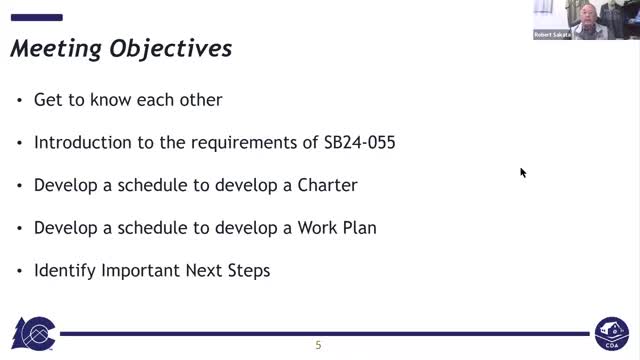
Summary
State officials and rural health providers met in a virtual session to launch a legislatively mandated workgroup to address behavioral-health needs among Colorado farmers, ranchers and agricultural workers; members set meeting cadence, staffing priorities and outreach goals and were briefed on open-meetings and ethics rules.
Colorado agriculture and health officials convened a virtual meeting of a new workgroup intended to address behavioral-health needs in farming and ranching communities and to meet a statutory requirement for an initial convening before Jan. 1, 2025.
The group, co-led by staff from the Colorado Department of Agriculture and including representatives from the Colorado Department of Public Health and Environment, university extension programs, farm organizations and rural health providers, outlined objectives, staffing priorities and a meeting schedule and received instruction on Colorado open-meetings and ethics obligations.
The workgroup’s establishment responds to language in the enabling legislation that requires membership from specified constituencies and a first meeting before the January 2025 deadline, a point staff said the session satisfied. Members said the group will focus on suicide prevention, stress management and culturally appropriate outreach to farmers, ranchers, agricultural workers and their families.
Meghan Shotton, introduced in the meeting as the director of strategic planning working with behavioral-health administration, said the agency is developing a training and plans to recruit a program developer and a community-engagement specialist to focus on outreach to agricultural and rural communities. Meghan said those positions would emphasize reaching farmers, ranchworkers and families and working collaboratively with the Department of Agriculture.
Katherine Harvey, who identified herself as a strategist in the Office of Suicide Prevention at the Colorado Department of Public Health and Environment, described that office as the primary state entity for suicide prevention and said it already provides funding and prevention supports that can be directed to communities.
Robert (CDA staff) and a co-presenter identified as Clinton explained that the workgroup will draft a “chapter” (a guidance/plan document) for review by members. Staff asked members to submit feedback on the draft chapter by Jan. 10 so the group can finalize material before a next full meeting scheduled for Jan. 28. Members expressed a preference for meeting monthly as required by statute but discussed alternating shorter and longer sessions; staff proposed holding regular meetings on the fourth Tuesday each month during the early-afternoon window.
Members raised representation gaps the legislation requires be filled, specifically tribal representation from the Ute and Ute Mountain Ute communities; staff asked attendees to help identify tribal contacts. Participants also requested outreach and language access for Spanish-speaking agricultural workers and said they want culturally tailored resources.
Participants from university extension and farm organizations described existing programs and local contacts. Julie Elliot, identified as a behavioral-health specialist affiliated with Colorado State University extension, and J.C. (representing a rural federally qualified health center) noted ongoing prevention work and said they can share program models the workgroup could spotlight during longer sessions.
Several community providers described on-the-ground activities: Michael Lozano outlined a veterans-focused equine-therapy program that combines clinical supports, peer engagement and USDA grant funding; other members described county coalitions, FQHC work and collaborations across extension, unions and community mental-health providers.
Bethany Cou and a staff trainer from the department provided a required orientation on legal and ethical responsibilities for members. The training covered Colorado open-meetings obligations (often called the “sunshine” laws), public-records expectations, conflict-of-interest rules and the duty to recuse from decisions when members have personal or organizational conflicts. The trainer emphasized that “meetings” can include in-person gatherings, virtual calls, telephone discussions and certain serial electronic communications when they constitute deliberation of public business.
No formal motions or votes were recorded during the session; staff identified next steps and assignments: circulate the draft chapter, collect comments by Jan. 10, publish meeting materials on the CDA website and hold the next meeting on Jan. 28 with a recurring monthly cadence thereafter. Staff also said they will continue outreach to identify missing constituency representatives and provide meeting materials in accessible formats.
The session combined orientation, membership introductions, program sharing and administrative planning; participants asked that future meetings include presentations highlighting model programs and that the group maintain attention to cultural validation and Spanish-language access. Staff said they will follow up with an email containing meeting materials, links and QR codes and will coordinate with legal staff on any unresolved questions about open-meetings or ethics guidance.