
State shifts behavioral health funding to regional administrators, presenters say
Get AI-powered insights, summaries, and transcripts
Subscribe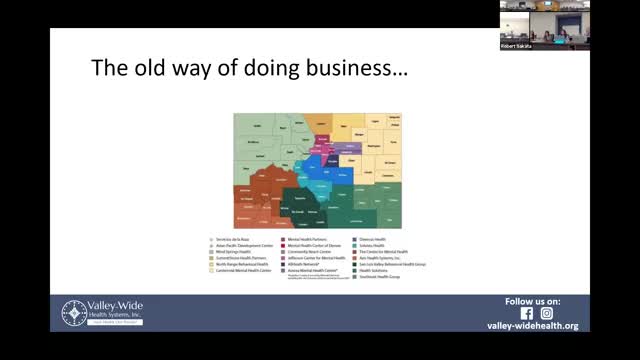
Summary
Presenters at a Colorado Rural Behavioral Health Workgroup meeting described how the newly created Behavioral Health Administration will route federal and state behavioral health dollars through regional administrative organizations, changing how providers apply for and receive funding and creating new opportunities tied to Medicaid and CCBHCs.
Colorado’s new Behavioral Health Administration (BHA) will channel federal and state behavioral-health funding through regional administrative organizations, local presenters said at a workgroup meeting at Colorado State University Pueblo. The change, which speakers said stems from recent state legislation, will require many providers to contract with regional entities rather than the state directly.
Workgroup presenters said the administration’s structure groups counties into larger purchasing regions that will manage funds, set provider networks and award contracts for behavioral-health services. That structure is intended to create a centralized “system of care” and reduce fragmentation of separate funding streams for mental health, substance-use treatment and care navigation.
The shift matters because it changes how grant and contract dollars flow. Presenters said some federal and state funds — including dollars tied to Medicaid and grants for medication-assisted treatment — will be routed through the regional organizations. That makes the regional entities a likely place for local agencies and coalitions to pitch program proposals and seek funding, speakers said. They also recommended that local organizations approach those entities collaboratively rather than solo to improve competitiveness.
Presenters discussed a separate but related federal opportunity: the certified community behavioral health clinic (CCBHC) model. They said CCBHC designation can unlock additional federal Medicaid funding and that states that align with the CCBHC model may receive substantial federal Medicaid dollars. One presenter noted that more federal funding is available to states that implement that model, while other presenters cautioned that adopting a state-specific system could affect eligibility for some federal funds.
Several presenters emphasized that the new regional model will be competitive and that rural applicants should consider coalition approaches to demonstrate coordinated care and population-level impact. Workgroup members asked for clarification about which dollars will be distributed regionally and which will be targeted to specific services; presenters said some funds will be earmarked (for example, for medication-assisted treatment), while other funds will be allocated at the regional entity’s discretion.
Speakers urged rural providers and community groups to engage with the regional administrators early, to align project proposals with regional priorities and to consider partnering with other organizations to increase chances of funding. Presenters also recommended monitoring how the state’s approach evolves, because policy changes could affect how funds are routed and which programs are prioritized.
Workgroup members and presenters said follow-up actions include outreach to the regional administrators, tracking state guidance on implementation, and preparing collaborative proposals that align with regional priorities. The meeting did not record any formal votes or binding policy decisions on this topic.