
OCPS outlines $3.7 billion capital plan, schedules relief schools and renovations
Get AI-powered insights, summaries, and transcripts
Subscribe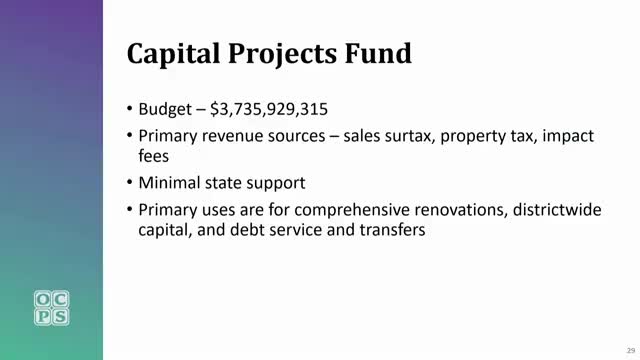
Summary
District finance staff presented a $3.7 billion capital projects budget that relies on sales surtax, property tax and impact fees and funds renovations, relief schools and districtwide projects.
Orange County Public Schools’ capital budget for 2025–26 is $3.7 billion and funds comprehensive renovations, relief schools, capacity projects and districtwide capital needs, district staff told the school board Sept. 9.
Erneston Baptiste, director of the Office of Management and Budget, and CFO Doreen Concolino presented the capital plan during the budget hearing. Baptiste said the capital program is supported primarily by three revenue streams: sales surtax, property tax (capital mill) and impact fees.
Baptiste described projections the district used in building the five‑year capital plan: sales‑surtax revenue of about $383.7 million for the fiscal year, impact fee collections forecast at about $59 million, and anticipated capital mill receipts of about $363.5 million (with roughly $16.5 million of the capital mill shared with charter schools as required by state law). The presentation also noted an $8.6 million state appropriation for capital outlay specific to traditional schools and an estimated $11.7 million in charter capital (PICO) pass-through funds.
The district’s recommended uses include comprehensive renovations (58% of the capital budget), districtwide capital projects (20%), debt service and transfers (8%) and funds for school openings. The five‑year plan includes funding to build 13 relief schools (nine elementary, two middle and two high schools) and to continue design and construction work on numerous renovation projects; several pre‑2003 schools remain on the prioritized renovation list.
Baptiste said the capital budget includes carryforward funds for projects already in progress and continues transfers to capital renewal per the sales‑tax referendum. Concolino noted the capital program assumes updated impact fee studies and state allocations yet to be finalized.
“Carry forward funds are incorporated into the budget,” Baptiste said. “The largest portion of our budget is used for comprehensive needs at 58 percent.”
Board members noted the plan relies heavily on local revenue streams and observed that state contributions for capital remain limited, increasing local reliance on surtax and property tax for school construction and renovations.