
Board denies variance request tied to driveway deed swap; members urge easement instead
Get AI-powered insights, summaries, and transcripts
Subscribe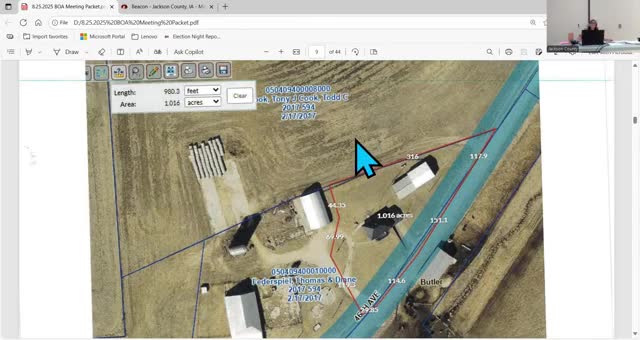
Summary
The Board of Adjustment denied a variance sought by Mark and Julie Heights that was triggered by a proposed deeded land swap with neighbor Dennis Althouse; members said a negotiated easement would address driveway access without creating a zero‑setback garage issue.
The Jackson County Board of Adjustment on Aug. 25 denied a variance request from Mark and Julie Heights that arose after the couple and their neighbor, identified in the record as Dennis Althouse, agreed to a reciprocal deed transfer designed to provide Althouse with direct legal access to his back parcel.
Becca, zoning staff, told the board the Heights parcel contains about 40,075 square feet (just under an acre) and had been rezoned from A1 to R1 to allow division into two conforming lots under the R1 minimum of 20,000 square feet. The proposed deed swap would transfer 20 feet on the east side of the Heights parcel to Althouse for a driveway and, in return, transfer 30 feet on the west side to the Heights to be added to adjacent farm property.
Because the transfer conveyed ownership rather than an easement, the change in the property line created an apparent setback encroachment: an existing detached garage built in 1976 would sit too close to the new line. Mark Heights proposed cutting 6 feet from the rear of the garage to make it a 24‑foot deep structure, and asked the board to approve a zero‑foot side setback to preserve the remainder of the garage.
The applicants and neighbors described a long effort to secure a direct driveway under state highway access rules; the Heights said Department of Transportation constraints and steep grade made a new highway driveway infeasible and that the deed transfer was the practical alternative. The Heights said the deed swap had been pursued after prior advice from county staff and legal work was prepared.
Board members and the record indicated an easement would resolve the access problem without creating a zero‑setback building next to a neighboring parcel. Members raised concerns that a recorded zero‑setback would create long‑term maintenance and access problems if future owners disagreed. One board member said an easement “would give him all of that” (referring to driveway access) without shifting ownership and property‑tax consequences.
After discussion and a second, the board moved to deny the variance request and encouraged the parties to pursue a formal, surveyed easement and to finalize deeds and surveys with counsel. The board recorded that the motion carried.