
Palm Coast transmits 20-year water supply work plan to state; staff highlight brackish wells and conservation
Get AI-powered insights, summaries, and transcripts
Subscribe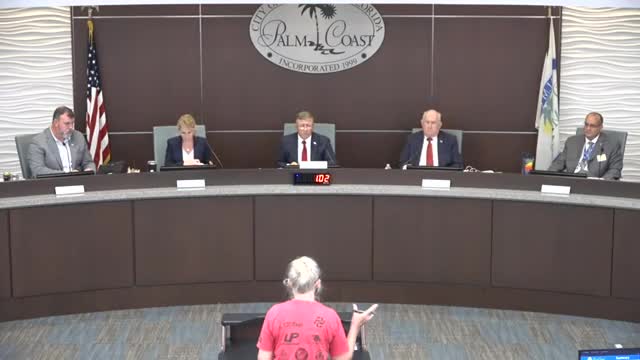
Summary
The City Council voted unanimously to transmit a comprehensive-plan amendment incorporating the Water Supply Facilities Work Plan, a 20-year utility plan that includes brackish-well exploration, conservation and infrastructure needs; staff and residents debated capacity, costs and infiltration issues.
The Palm Coast City Council voted unanimously to transmit an amendment to the city's 2050 Comprehensive Plan that incorporates the Water Supply Facilities Work Plan, a 20-year utility planning document staff said is required by state law and intended to align land-use decisions with available water supply.
Peter Russell, deputy director of utilities, presented the plan as a long-term framework covering the full utility service area and projects necessary to meet projected demand over 20 years. Russell said the city's average daily flows are currently trending below previous projections and that the utility has implemented recovery and blending projects that reduced discharge to surface waters. "Since the onset of [blending] in April 2011, we have saved 2,600,000,000 gallons of water since then," Russell said. He added that a separate recovery project at Plant 2 dating from March 2015 has saved about 1,900,000,000 gallons; together those projects total about 4,500,000,000 gallons recovered. Russell also stated the recovery projects can recover "up to about 1,900,000 gallons per day."
Staff told the council the plan projects the city would exceed its current allocation from the Upper Florida aquifer and related sources (recorded in the presentation as an 11,025,000 gallons-per-day allocation) in 2025. To address near-term needs, the plan proposes requesting a modification to the city's consumptive-use permit and acquiring additional wells on the Otis Stone well field while the city pursues alternate supplies, including brackish-water development and reclaimed-water uses. Russell described the technical definition used in the presentation: "1,000 milligrams per liter to 10,000 milligrams per liter would be, would indicate a brackish water supply."
Council members and residents engaged in extended discussion about capacity, cost and the distribution of expenses between current and future residents. One council member noted that 19,000 housing units are currently in the development queue and asked whether the capital improvements included in the plan would leave current residents paying disproportionately for upgrades. Staff responded that the capital improvement plan and impact-fee methodology allocate growth-related costs to future development to the extent permitted by law, while other infrastructure maintenance costs are borne by current customers.
Residents who spoke during public comment expressed differing views. Jeanie Duarte said she was concerned about plans to mix brackish water, graywater and reclaimed wastewater and argued the city should focus on existing treatment-plant problems: "They cannot guarantee our city's health and safety 100%." Tony Amaral commended staff for the presentation and said the plan "will ensure that we have the capacity for the wastewater and for the water because we are getting ahead of the curve." Mark Webb urged the council to emphasize reducing infiltration and inflow (I&I) into the wastewater system and encouraged broader consideration of on-site options such as supplemental irrigation wells and reverse-osmosis systems.
City staff described next steps: the council's transmittal to state agencies will be followed by review by the Planning and Land Development Regulation Board, a 30-day state-agency review period and a second public hearing before the council in October for final adoption. A staff member said the work plan and its projections will be updated when the St. Johns River Water Management District updates its regional water-supply plan on its five-year schedule.
A motion to transmit the comprehensive-plan amendment carried with a unanimous roll-call vote. The transcript records that a motion and second were made and that Vice Mayor Pontieri, Council member Mill (Miller), Council member Sullivan and Mayor Norris voted yes; the clerk announced the motion passed unanimously.