
Scott County Fiscal Court declines ordinance allowing street-legal special-purpose vehicles
Get AI-powered insights, summaries, and transcripts
Subscribe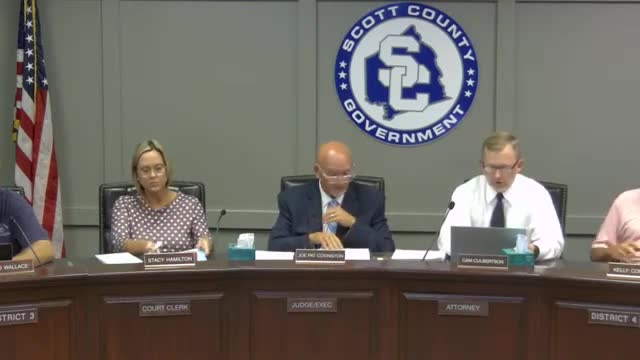
Summary
After public comment and debate, the fiscal court voted against Ordinance 25‑02, which would have allowed street‑legal special‑purpose vehicles on specified county highways under KRS provisions. The ordinance included exceptions for Georgetown, Stamping Ground and Sadieville and a 20‑mile limit on centerline‑marked roads.
GEORGETOWN, Ky. — The Scott County Fiscal Court voted on Aug. 28, 2025, against Ordinance 25‑02, a measure to permit street‑legal special‑purpose vehicles on county highways under KRS 186.077 and KRS 186.078. The ordinance text the court read would have allowed those vehicles on publicly maintained county highways with a number of exceptions and operating limits.
The court’s reading of the ordinance cited state law that authorizes counties to allow specially defined vehicles to operate on highways if the local government adopts an ordinance; the draft ordinance adopted those KRS definitions by reference and listed exceptions, including highways inside Georgetown, Stamping Ground and Sadieville and any controlled‑access highways. It also would have prohibited travel of more than 20 miles on highways that display centerline pavement markings.
Supporters at the public hearing said the ordinance protects individual liberties and provides a regulatory framework that encourages inspection, insurance and licensing. “It’s a heavy burden to potentially say no to someone even if you don’t like it,” said Mark Smith, a resident and business owner who spoke in favor of the ordinance. Dwayne Power, who identified himself as the owner of a 2023 Kawasaki Mule, said his side‑by‑side includes lights, radial tires and other equipment and that he would register and plate the vehicle if allowed: “I would pay the taxes and get the plate for mine.”
Opponents and some magistrates said the state law’s original sponsor framed the bill as intended to support trail tourism in certain eastern and western counties, not to blanket all counties, and that Scott County currently lacks the public or private trail systems that drove that intent. One magistrate who opposed the ordinance said that because the county does not have extensive trail systems, allowing the vehicles would not produce the tourism benefits cited by proponents.
The motion to adopt the ordinance was followed by a roll‑call vote. The recorded votes were: Oscar — yes; Johnson — yes; Pratt — yes; Wallace — no; Cornyn — no; Ellison — no; Livingston — no; Judge Covington — no. The tally resulted in more no votes than yes votes; the ordinance did not pass.
The ordinance text and the public exchange also raised operational questions not fully defined in the draft, including whether the 20‑mile limit is one‑way or round trip and how the ordinance would interact with existing practices—such as farm equipment or triangle markers currently used by some operators. Cody Meadows, who identified himself as a Stamping Ground city commissioner, told the court that Stamping Ground already allows golf carts under its own ordinance and said the city may consider its own rules going forward.
The court closed the public‑comment period after the vote and moved on to other agenda items.
Why this matters: The decision preserves local roadway restrictions in place and leaves the status quo unchanged for owners of off‑road and utility vehicles in Scott County. It demonstrates a split among magistrates and residents between claims of individual liberty and concerns about traffic, safety and compatibility with local infrastructure.